 |
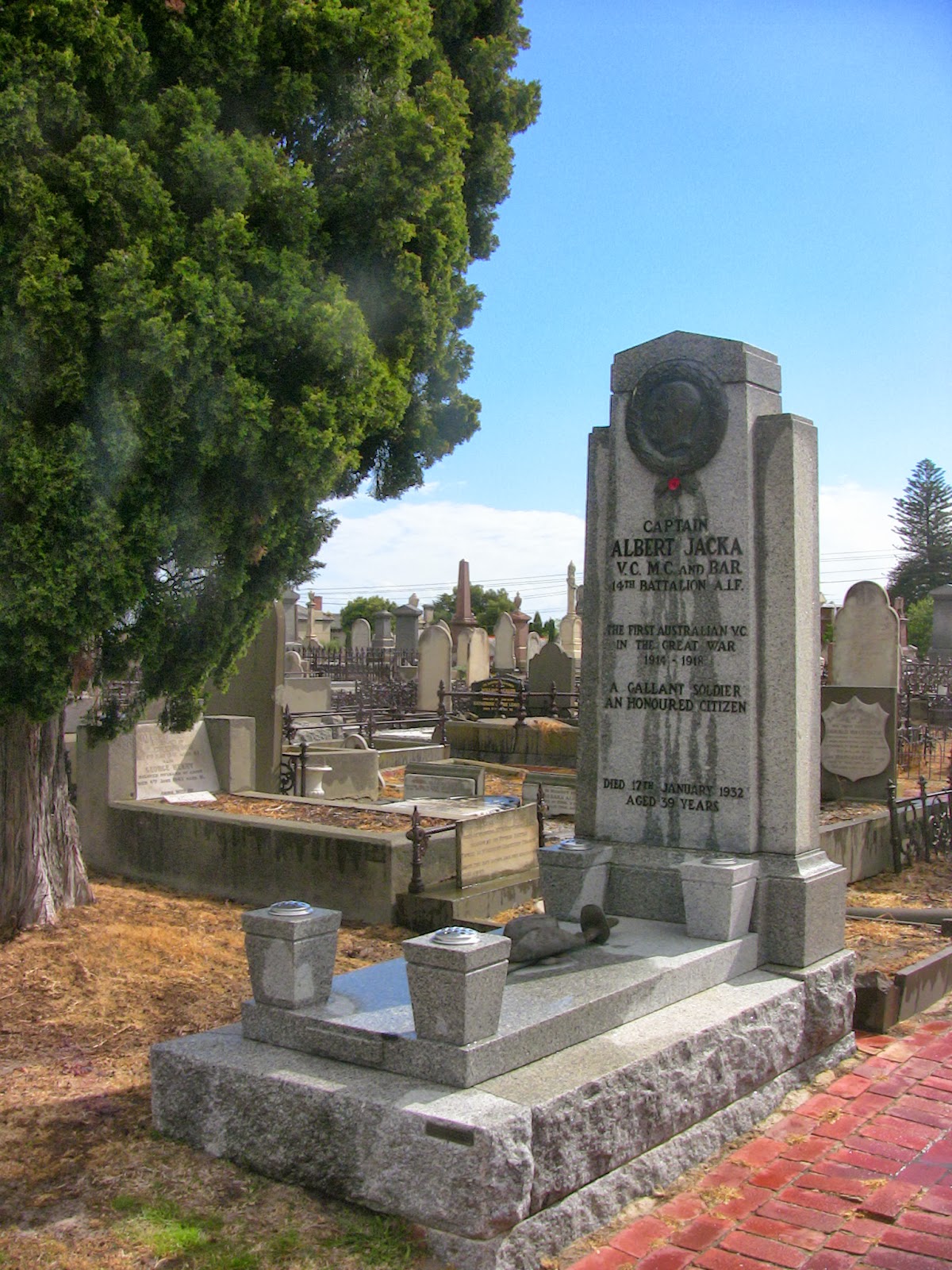
| The Grave of Captain Albert Jacka VC, St Kilda Cemetery, Melbourne, October 2013. Photograph Jim Claven |
Corporal Albert Jacka was one of Australia's most famous Anzacs. He was the first to be awarded the Victoria Cross in the First World War for his bravery in the field at Gallipoli. But like almost all Anzacs at Gallipoli, he knew Lemnos, visiting this important rest and hospital base on a number of occasions.
The 21 year old labourer Albert Jacka enlisted in the AIF on 15 September 1914 as Private 465 in the 14th Battalion. Albert and his unit departed Port Melbourne aboard the HMAT Ulysses on the 22nd December 1914. Following training in Egypt, he arrived at Lemnos’ Mudros harbour before the landings on 25th April. As Albert’s transport ship, the Rangoon trader the SS Seang Chong, entered Mudros’ large harbour on 15th April, it was joining a huge Allied armada that was assembling in the harbour. Albert noted in his diary his awe at the sight of the hundreds of Allied ships collected there. It is also recorded that he secured a lifeboat and used it to visit one of the British fleet’s great new dreadnought battleships, the HMS Queen Elizabeth, preparing for the Gallipoli campaign.
 |
| HMS Queen Elizabeth in Mudros Harbour, 1915. AWM image |
Along with his unit, Albert left Mudros for Anzac Cove at 10am on Sunday, 25th April. Jacka and his unit would be sent to defend the vital Courtney’s Post, as the Ottoman forces desperately tried to throw the Anzacs back into the sea.
The 22 year old Albert was awarded the Victoria Cross for his brave actions at Courtney's Post, Gallipoli, on 19 May 1915. This was the first VC to be awarded to the AIF in the First World War – and would be only the first of Jacka’s military decorations.
 |
| The view to the Turkish lines from Courtney's Post, Gallipoli peninsula. 1915. AWM image |
Like many Anzacs, Albert would suffer from one of the main sources of incapacitation at Gallipoli – gastric disorders – and these would bring him to Lemnos and its Australian medical services. His service record shows that he was sent to the 1st Australian Stationary Hospital suffering from diarrhea on the 19th July. Albert returned briefly to Lemnos, being treated at the 24th Casualty Clearing Station at Mudros between 25th and 27th August for gastritis.
 |
| 2nd Australian Stationary Hospital, Turks Head Peninsula, Lemnos. 1915. AWM image |
When his unit returned to Lemnos for a six-week recuperation on Lemnos on 14th September, Albert was now a celebrity. He was presented, along with General Monash, to the French Naval Commander-in-Chief, who is reported to have embraced Jacka.
He returned to Lemnos after his units’ evacuation on 18th December and spent Christmas there, until his transport to Alexandria on 16th January. Like many of his comrades, Jacka again suffered from the major ailment of the campaign, dysentery during his final stay on Lemnos.
The already famous Jacka was photographed on Lemnos, outside his tent – which is reproduced below.
 |
| Corporal Albert Jacka on Lemnos, probably Sarpi Rest Camp, 1915. AWM image. |
After Gallipoli, Jacka went on to serve in France where he was awarded the Military Cross for his action durign the battle of Pozieres in August 1916. To this was added the bar to the Military Cross for his bravery at Bullecourt in April 1917. He was wounded at Messines in July 1917 and badly gassed in May 1918.
 |
| HMAT Euripides photograph with signatures of Anzac soldiers who sailed on her back to Australia in 1919, including Albert Jacka. AWM image |
He returned to Australia aboard the HMAT Euripides. His bravery and awards meant that Jacka was often featured in post war "Peace Loan" posters. The "Peace Loan" were bonds issued to help the Australian Government recoup the costs of the war and to fund the pensions of the the hundreds of thousands of returned soldiers.
 |
| Post war peace bonds poster from South Australia. 1918-19. AWM image. |
He would become the Mayor of St Kilda and be noted for his actions to provide assistance to the unemployed during the depression.
 |
| Drawing of Albert Jacka as Mayor of St Kilda. AWM image. |
He died in 1932, his coffin being carried by 8 Victoria Cross winners.
Albert Jacka is one of the strong links between Melbourne's City of Port Phillip, Lemnos and Anzac. Not only did he depart for Lemnos and Gallipoli from the wharves of Port Melbourne, but when he returned to Australia after the war he would become one of the most memorable civic leaders of the City of St Kilda, a precursor municipality of Port Phillip.
Jim Claven
Secretary, Lemnos Gallipoli Commemorative Committe


