Help us promote Lemnos' link to Anzac - Make a donation now

Our Committee is raising funds to create a lasting legacy telling the story of Lemnos' link to Gallipoli and Australia's Anzac story. Our projects include the Lemnos Gallipoli Memorial in Albert Park, the publication of a major new historical and pictorial publication and more. To make a donation you can also deposit directly by direct debit into the Committee's bank account: Account Name: Lemnos Gallipoli Commemorative Committee Inc; Bank: Bendigo Bank; Account No: 188010037; BSB No: 633000; Include your surname in the reference section. For further information on our legacy projects or to make a donation please contact either Lee Tarlamis 0411553009 or Jim Claven 0409402388M

Wednesday, 5 April 2017

Anzac Commemorative Service - Caulfield Hospital (Formerly No 11 Australian General Hospital and Repatriation Hospital) - 2pm 24th April 2017

Caulfield Hospital Memorial stone, Anzac Service 2014, Courtesy of Nelson Brothers Funerals Facebook page 6 April 2017
It has come to our attention that Caulfield Hospital will hold its annual commemorative service at 2pm, Monday, 24th April. The service will take place near the front gates, in front of the memorial stone, at the hospital, 260 Kooyong Road, Caulfield.
Caulfield Hospital was formerly known as No. 11 Australian General Hospital (AGH) or later the Caulfield Repatriation Hospital. The original "Glen Eira" mansion (built in 1865) was purchased by the Department of Defence in 1915 and from 1916 opened its doors to treat injured and disabled soldiers from WWI. The hospital was renamed Caulfield Hospital in 1959. The Hospital has continued to maintain this strong link with the veteran community.
In 1966 a history of the hospital was published titled "The wounded warrior and rehabilitation: including the history of no. 11 Army General Hospital - Caulfield Rehabilitation Hospital". This was published by The Alfred Healthcare Group [Caulfield general Medical Centre] The book was written by Bruce Ford, a former Medical Director of Caulfield Hospital. Sadly the book has been long out-of-print but moves are afoot to possibly re-publish this important addition to our Anzac literature and history.
Lemnos Connection - Albert Jacka
No doubt many of the diggers who fought at Gallipoli and walked on Lemnos were given care at the Hospital after they returned from the war.
One of these was Captain Albert Jacka, who died at the Hospital, succumbing to the effects of his many war injuries, after collapsing duyring the St Kilda City Council meeting on 17 January 1932. Albert had come to Lemnos during the Gallipoli campaign on a number of occasions, incluyding when ill. He was famously photographed on the Island in 1915. He was also paraded before visiting military dignitaries after his being awarded Australia's first Victoria Cross of the war.
You are Invited
With its grand military history as a Repatriation Hospital, Caulfield Hospital holds an annual ANZAC Service next to their Memorial Stone in the gardens of the hospital.The event is attended by local councillors & MPs, representatives of the Caulfield RSL, and patients and staff of the hospital and nursing home. It is a moving ANZAC Service with recitations and bugler. All are welcome to attend.
Images from the past
To illustrate No. 11 Australian General Hospital (AGH)'s important role in Australia's veteran and nursing history, below are some photographs of the Hospital held in the archives of the Museum of Victoria


The last image is that of a magazine - The Caulfield Cripple - produced as a souvenir Anzac Day Edition in 25 Apr 1917. It was produced to commemorate the second anniversary of the Anzac forces' landing in Gallipoli. It contains contributions from present and past hospital patients and staff members, including articles, poems and correspondence.
The following images of the Hospitals Memorial stone were taken by Georgia Pernitzis.


Thanks to George Pernitzis for letting me know about this service and to the Museum of Victoria, Glen Eira Rotary and Nelson Brothers Funeral Services for making some of this information available on-line.

Jim Claven
Secretary
Lemnos Gallipoli Commemorative Commitee


Tuesday, 4 April 2017

Lemnos or Salonika? Australian nurses and soldiers rest by the bay

Lemnos or Salonika?

This famous image of diggers and nurses in Greece during the First World War is emblematic of the experience of the Anzacs in Greece. Over 50,000 Australians came to Greece in the war, the vast majority serving on Lemnos (and the nearby then-Greek held Islands of Imbros and Tenedos), with others serving on the Salonika Front, centred around modern day Thessaloniki.

The image features on Professor Bruce Scates' great novel about the Gallipoli campaign - On Dangerous Ground:

However the official title of this image is however wrong. The Australian War Memorial records that it was taken in "Salonika" and depicts:

"View of the 60th British General Hospital. Note the large Red Cross in the centreground. This is the centre image in a three part panorama."

The first thing to say about this is that this is not a view of the 60th British General Hospital and there is no Red Cross in the centre ground. Also there were very few diggers on the Salonika front, and these only for a few weeks around late 1915 and early 1916.

The AWM archive states that the image is part of a three part panorama - and indeed two other images connected to it are of the 60th British General Hospital at Salonika (A02205A and A02205C). But sadly the third photo (A02205B) has been misplaced and this photo archived incorrectly.

It is in fact clearly the view from near the Australian hospitals on Lemnos' Turks Head peninsula, looking across the small cove to the west in the foreground, with the causeway leading to the small Greek Orthodox church - Agios Nikolaos (if I am not mistaken) - jutting into Mudros Bay - a causeway and the church that stand to this day.

Below is one of my photos of the church and causeway, taken in the centenary year of 2015, when I took the descendants of Brisbane's Matron Grace Wilson, on a personal tour of the area. The photo below was taken from a position not far from that wear the diggers and nurses sat in 1915.
  

I have sent a submission to the Australian War Memorial of the need to correct the title of this photograph.

 Jim Claven
Secretary
Lemnos Gallipoli Commemorative Committee

Sunday, 2 April 2017

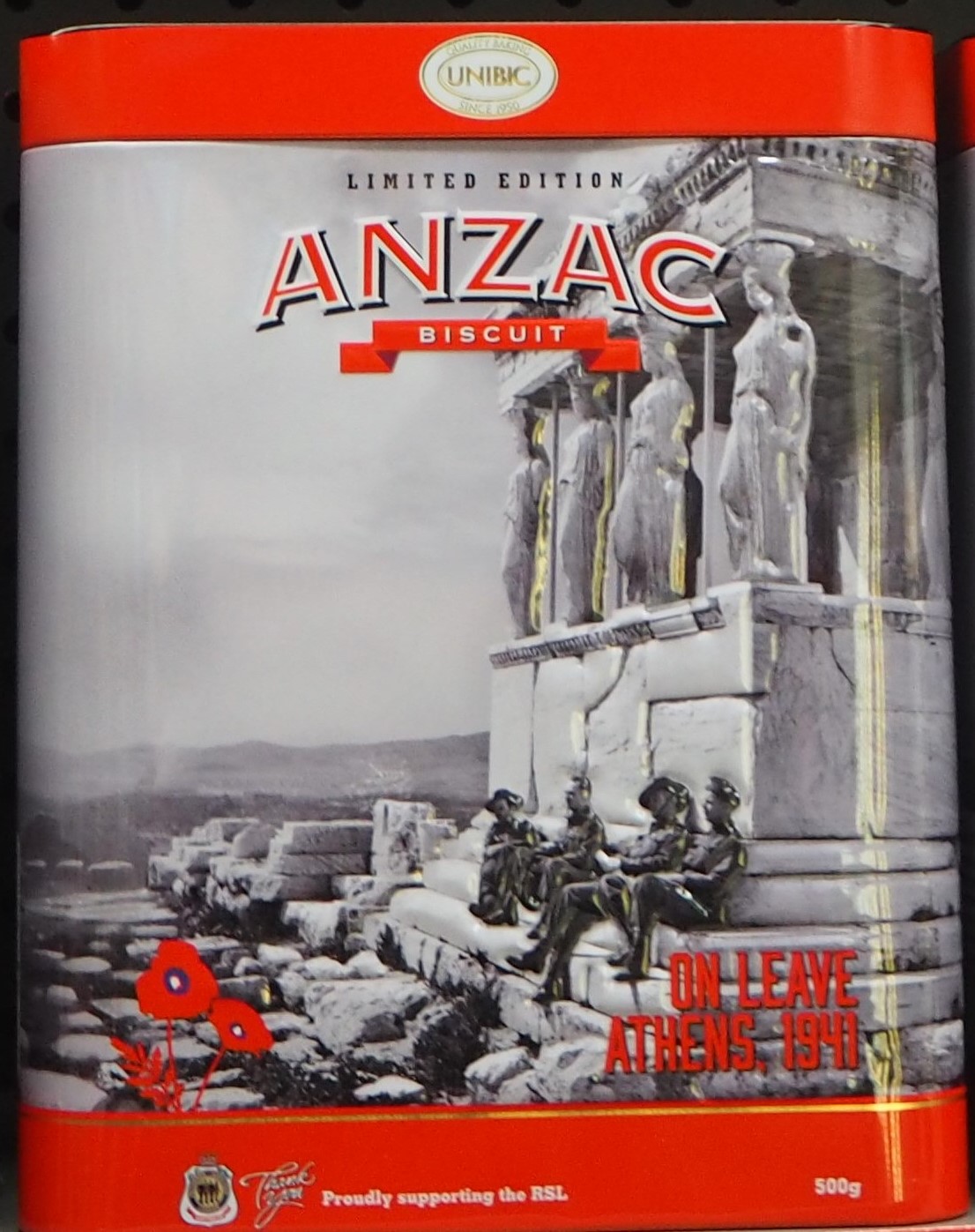
Out Now! - Anzac Biscuit Commemorative Tins Honour the Anzacs in the Greek and Crete Campaigns of 1941


Anzac Biscuit Commemorative Tin. Photo Jim Claven 2017
An iconic image of Australian diggers on the Acropolis in early 1941 will feature on the UNIBIC Commemorative Anzac Biscuit Tin. These tins – which contain Anzac biscuits - are produced by UNIBIC with proceeds going to the RSL to support its work assisting veterans and their families.
Each edition of the tin is adorned with a historic image from Australia's ANZAC legend. This is the first time that an image from the Greece and Crete campaigns has featured on the tins. The initiative is the result of a proposal from Mr Tony Tsourdalakis on behalf of the Battle of Crete and the Greek campaign Commemorative Council.
The Anzac Biscuit Tins help raise awareness of the Anzac involvement in the Greek and Crete campaign of 1941. Photo Jim Claven 2017

Mr Tsourdalakis, who is Secretary of the Council, said that it was a great honour to have Greece and its connection to Anzac chosen to feature on this year’s commemorative tin.It will bring the story of the Anzacs in Greece to thousands of homes across Australia. What a great gift for your friends and loved ones!
Anzacs on the Acropolis. AWM
The image is one of the most iconic photographs of the Australian involvement in the Greek campaign held in the Australian War Memorial in Canberra.
It shows diggers on the Acropolis, resting beneath the famous Caryatids of the Erechtheion. It symbolizes the experience of Greece and its culture by the thousands of Australian soldiers and nurses during the campaign in Greece and Crete. Soon these relaxing diggers sitting on the Acropolis would move north to join with Greek and other Allied troops to face the looming German invasion of Greece.
Photo Jim Claven 2015
The image is so famous that it was used by the Australian Government to promote the 70th anniversary of the Battle of Greece and Crete in 2011.
Poster produced by the Australian Department of Veterans Affairs, 2001

For all those interested in the Hellenic link to Anzac - go out now and buy yourself one of these iconic tins before they sell out!
The Tins can currently be purchased at major IGA supermarkets but should be available from other outlets in the future.
Hopefully we will have more iconic images from the Hellenic link to Anzac on the tins in the future!
Well done to Tony and all involved in the Battle of Crete and the Greek Campaign Commemorative Council.
Jim Claven
Secretary, Lemnos Gallipoli Commemorative Committee
Member, Battle of Crete and the Greek Campaign Commemorative Council

Wednesday, 22 March 2017

Lemnos or Imbros? - Greek labourers and the Gallipoli campaign

Greek labourers during the Gallipoli campaign, 1915. IWM/KCL

The photograph above is one of the evocative images of the Greek civil involvement in the Gallipoli campaign. Here are Greek workmen, some appear to be carpenters, working on the edge of a bay. But where is it?
Greek labourers volunteered to work for the Allies during the Gallipoli campaign. Various sources reveal that these labourers came from many locations - Lemnos, Lesvos, Imbros, Tenedos and Asia Minor - and no doubt many other locations.
The identification of the location of photographs taken in 1915 can be a difficult process. Photographs have been filed incorrectly over the years. Some photographers were confused, maybe trying to specify locations weeks or months after the fact.
The photograph above was taken by the British war photographer Lieutenant Ernest Brooks in 1915.
A copy of the photograph is held in the Imperial War Museum (IWM) in London. The description of the photograph says that it depicts "civilian carpenters at work at Mudros. In the background can be seen the shipping in the harbour."
However, another copy of the photograph is held in the archives of King's College, London, (KCL) in the collection of the former British General Ian Hamilton, the commander at Gellipoli for most of the campaign. This original has words written on the back stating that the photograph is of "Hundreds of Greeks employed on Imbros Island in various tasks."

Having visited both Lemnos and Imbros Island's I now feel convinced that the photograph is more likely to be of Kephalos Bay on Imbros - and not of Mudros Bay on Lemno. Below are some photos I recently took of Kephalos Bay on Imbros, where you can see in seperate photographs a similar gradient to the hill on the left of the 1915 photo and the sharp cliff of the promontory at Kephalos, similar to that on the right distance of the 1915 photo. But then again ...


Jim Claven
Secretary
Lemnos Gallipoli Commemorative Committee


Tuesday, 21 March 2017

Latest RSL Mufti Magazine - Unveiling of Peter Corlett's New Statue, Hellenic RSL News and Anzac Day March Details


The latest edition of the RSL magazine Mufti contains reports on a number of items of interest to our Commitee.
Firstly, there is a report on the unveiling in Ballarat of Peter Corlett OAM's new commemorative statue - The Grieving Mother. See the page below:

Secondly, there is a report on last years conferring of Greek Medal of Honour for service in the Greek campaign in WW2. Thanks to Manny Karvelas, Senior Vice President for getting this important event covered in the RSL magazine - and of course for his magnificent photographs! See the page below:

Thirdly, the magazine publishes the details for assembly for this years Anzac Day march. For example, the 6th Division (those troops who served in Greece and Crete) will assemble at Flinders St East (St Paul's side), departing at 9.45am. The Hellenic veterans (along with Scottish and other veterans, and WW1 and WW2 descendants) are to assemble at Flinders Walk, departing at 11.50am. See the pages below:

Jim Claven
Secretary
Lemnos Gallipoli Commemorative Committee

Monday, 20 March 2017

Peter Vakirudis - The story of a would-be Digger of Lemnian descent

Attestation form of Peter Vakuridis, May 1918. NAA
There are two recruits to the AIF in WW1 connected to the Greek Island of Lemnos. one is Basil Demetri Passa from the village of Kontopouli on Lemnos. Dimitri joined the AIF and served in France. For more information on Basil, please click here.
The other is Peter Vakirudis and his mother was living on Lemnos when he attempted to enlist at Albury in NSW. This is his story.
A Hellene Attempts to Enlist
Peter Vakirudis tried to enlist at the Albury recruitment centre into the Australian Imperial Force on 28 May 1918, aged 18 years and ten months. He was enlisted as Private 91681 into the AIF Depot.
He listed his profession as a labourer – a very common profession for AIF recruits. He gave his address as Balfour Street, Culcairn in the south-east Riverina region of NSW. This was 50 kilometres north of the recruitment centre in Albury. Most likely Albury was the closest recruitment centre for him.
He said that he was born in Alexandria in Egypt on 15th August 1899. He was 5ft 6 inches tall and weighed 130 lbs. He listed his religion as Greek Orthodox. He recorded his next of kin as his mother - Mrs Aristor Vakirudis. Her address was given as merely “Lemnos Island” (see the excerpt from his service record reproduced below). No village is mentioned in the Australian army documents.
Despite having passed his medical examination in June 1918, his enlistment appears to have been cancelled as it was impossible to gain his parents written consent – a requirement for someone under the age of 21 (see the excerpt from his service record reproduced below).
After the War
After the war Peter seems to established himself in Sydney and getting married - and possibly having children.
The Australian Electoral Roll shows that Peter was living in Sydney at least from 1933 until 1958, and most likely beyond that date. He was registered on the electoral roll (for the federal electorates of East Sydney, West Sydney, Hume and finally West Sydney again). This doesn’t necessarily mean that Peter moved residence, it may just mean the boundaries of the electorates changed.
In 1936 Sydney Council records show that Peter Vakirudis was paying rates for 220 Goulburn Street, Sydney (in the Macquarie Ward of the City). It was a brick house of 2 floors and 4 rooms, with an iron roof. It was owned by the estate of the late Sydney Herbert Cary. The rated gross annual value of the property was 39 pounds.
He is recorded as being married to Hazel Winifred Tilney from 1937. By 1967 Peter had died and been buried in Sydney. There is evidence that there were still some members of the Vakirudis family living in Sydney in 1980.
The Mystery of the Vakirudis’
It would be great to find out more about this apparently successful young Greek migrant from the large Greek community in Alexandria, Egypt.
  • When did he come to Australia and why?
  • Did he come with relatives and are any of his descendants still alive in Australia?
  • When did his family move to Alexandria from Lemnos and what did they do there?
  • And what of his mother and his descendents on Lemnos?
  • Where did his mother Aristor live and are there any relatives still alive?
These are just some of the questions that it would great to find out the answers too. Any help anyone can provide in tracking down more of the story of the Vakirudis' would be most welcome.
The information cited here is moistly sourced from Peter Vakirudis’ service file held by the National Archives of Australia.

Jim Claven
Secretary
Lemnos Gallipoli Commemorative Committee


Wednesday, 8 March 2017

New Lemnos Gallipoli Memorial Unveiled in Sydney - Congratulations from all of us in Melbourne!

The Lemnos Gallipoli Memorial, Sydney. Photos by Arthur Vergopoulos
For all of those who are not able to access the Lemnos 1915 Facebook page, below is reproduced the story and photographs taken of the recent unveiling of the new Lemnos Gallipoli Memorial on 4th March at Kogarah in Sydney.
Congratulations to all involved in erected this wonderful new statue. We know how much work must have gone into creating this lasting memorial.
With our Lemnos Gallipoli Memorial in Melbourne, we hope that these will help to build awareness of the role of Lemnos in the Gallipoli campaign for generations to come.
I am sure that when we visit Sydney in the future, all on our Committee will pay your new memorial a visit. Well done.If anyone would like information on our memorial in Melbourne's Albert Park, please click here for the story of our unveiling in 2015 and photographs from the event. We hold an annual service at the Memorial on the first Saturday following the 8th August, the date of the arrival of the Australian nurses on Lemnos in 1915. To read about last years service, please click here.
Again on behalf of all at our Committee in Melbourne, congratulations on a job well done.


Lee Tarlamis
President
Lemnos Gallipoli Commemorative Committee


Reproduced from Lemnos 1915 - "Unveiling sculpture ceremony of Anzac Nurse and Soldier:
A great morning at the unveiling ceremony of the Anzac Nurse and Soldier commemorative statue. This marks 102 years since the 3rd AIF disembarked on the Greek Island of Lemnos in preparation for the Gallipoli campaign. The work was created by Georges River Council’s first Artist in Residence, Athenian sculptor Takis Kozokos. Photos by Arthur Vergopoulos"

Reproduced from SBS:
"Μνημείο για τους ANZACs και την Λήμνο στην κεντρική πλατεία Kogarah
Μνημείο που καταδεικνύει τον σημαντικό ρόλο της Λήμνου στην εκστρατεία των ANZACs στην Καλλίπολη το 1915 κοσμεί εδώ και λίγες ώρες την κεντρική πλατεία του Kogarah, New South Wales, στα νότια προάστεια του Σύδνεϋ. Είναι έργο του Έλληνα καλλιτέχνη Τάκη Κοζόκου και δείχνει μία Αυστραλή νοσοκόμα να φροντίζει Αυστραλό τραυματισμένο στρατιώτη. Τα αποκαλυπτήρια έγιναν σήμερα το πρωί παρουσία: αξιαματούχων του Δήμου Georges River Council, αξιωματικού των Αυστραλιανών Ενόπλων Δυνάμεων, των ελληνικών προξενικών αρχών, ιερέων της Ελληνορθόδοξης Αρχιεπισκοπής, βουλευτών από την πολιτειακή κυβέρνηση και αντιπολίτευση, ομογενειακών παραγόντων και συμπαροίκων."


Photos from the unveiling by Arthur Vergopoulos below


Dr Stavros Kyrimis, Consulate General of Greece, Sydney
 
Photos by Liz Kaydos below


Photos by SBS below
Rosemary Dwyer, a descendant of Matron Grace Wilson, with Liz Kaydos of Lemnos 1915