Help us promote Lemnos' link to Anzac - Make a donation now

Our Committee is raising funds to create a lasting legacy telling the story of Lemnos' link to Gallipoli and Australia's Anzac story. Our projects include the Lemnos Gallipoli Memorial in Albert Park, the publication of a major new historical and pictorial publication and more. To make a donation you can also deposit directly by direct debit into the Committee's bank account: Account Name: Lemnos Gallipoli Commemorative Committee Inc; Bank: Bendigo Bank; Account No: 188010037; BSB No: 633000; Include your surname in the reference section. For further information on our legacy projects or to make a donation please contact either Lee Tarlamis 0411553009 or Jim Claven 0409402388M

Monday, 22 February 2016

Prahran's Link to Lemnos and Anzac - The Story of Private's George Drew and Peter Rados

Studio portrait of Prahran's Private George Drew. AWM

On Wednesday I will be speaking on Lemnos and Gallipopli at the Stonnington History Centre at High Street Malvern. Lemnos and Gallipoli is linked to many of Melbourne's suburbs and people. And no less in the City of Stonnington, which includes the previous municipalities of Prahran and Malvern.
Here is one part of that story - Prahran's Private George Drew and the Hellenic Anzac, Private Peter Rados.
Ari Burnu Cemetery, Anzac Cove. Photo Jim Claven 2013

There are many aspects of the Hellenic link to Australia's Anzac story. One of those lies in the small Commonwealth cemetery near Anzac Cove on the Gallipoli peninsula, Ari Burnu Cemetery.
Over 250 Allied soldiers are buried here, including 151 Australian diggers.
The beach at Ari Burnu. Anzac Cove. Photo Jim Claven 2013

Today, this Cemetery is located at one of the most beautiful locations on the peninsula. But in 1915 it was not so welcoming. It was one of the first cemeteries established after the Anzac landings nearby. Looking up from the beach, with the great physical feature named The Sphinx by the Anzac's looming above, it is not hard to comprehend how murderous these small landing places would have been for the diggers in 1915.
the grave of Private Peter Rados, Ari Burnu Cemetery, Anzac Cove. Photo Jim Claven 2013

Private Peter Rados, Hellenic Anzac
In the cemetery, lies Private Peter Rados of the 3rd Battalion AIF in grave plot G 21,the digger from Asia Minor. Having emigranted to Australia from nearby Artaky on the coast of the sea of Marmara, Peter had joined up at the beginning of the First World War, on the 18th August, aged only 23. The war brought him to Lemnos and to Anzac Cove. He was killed during a particularly fierce Ottoman attack on the morning of the 19th May. Peter was one of 12 Anzac's of Hellenic background who fought at Gallipoli and the only one to die on the peninsula.


The grave of Prahran's Private George Edward Drew, Ari Burnu Cemetery. Photo Jim Claven 2013

Prahran's Private George Edward Drew
Nearby lies George Edward Drew, in grave plot F 34. George Edward Drew was living with his parents at 31 York Street Prahran when he enlisted on 1st March 1915. A 28 year old railway employee, George was enlisted as Private 705 in D Company of the 23rd Battalion. He embarked from Princes Pier on the Euripides (A14) on the 10th May 1915. George arrived at Lemnos’ Mudros Bay at 5pm on the 2nd September 1915.
Lemnos' Mudros Bay, in April 1915. AWM
After two days at Lemnos, the 23rd Battalion sailed from Lemnos at 4pm on the 4th September 1915, headed for to Anzac Cove
He survived nearly three months defending one of the most deadly sections of the Anzac front line at Lone Pine. On 21st November 1915 George was killed in action – just a month before his Battalion would be evacuated from Gallipoli in December. He is buried in the same cemetery as Peter near the beach at Anzac Cove. George is also memorialised at the local Prahran RSL, located on High Street.
the famous WW1 Roll of Honour Board at the Prahran RSL. Photo Jim Claven 2015

Peter and George are two of the 151 Australian graves in this little cemetery. It was a moving experience for me to visit their graves in April last year. They are just two of the estimated 8,700 Australians who were killed as the campaign on the peninsula wore on for eight long months.
Prahran Greek Community present Greek Flag to the Prahran City Council in February 1941. Stonnington Historical Centre

Prahran, Anzac and Greece - Across Two World Wars and Beyond
Here George from Prahran lies next to the only Greek Australian Anzac to be killed at Gallipoli. A link between Prahran and Greece that would continue as Prahran itself would become the home to many Greek immigrants.
When war would unite Greece and Australia again in the Second World War, Prahran's Greek community rallied to support the Second Anzac's as the fought valiantly to support Greece against the Axis invader.
See the photo above, showing Prahran's Greek community presenting the Greek National Flag to the
Mayor of Prahran, Mr Alfred Woodfull, in Febraury 1941 to honour Greek patriots then fighting alongside the Allies in the defence of Greece and Crete. The Council Annual Report records that the flag was flown from the town hall on the day of the appeal for contributions to the war effort in Greece.
The Post-War era would bring tens of thousands of new migrants to Prahran, including from Greece.
Hawksburn Primary School. Source: Web.

As a young immigrant myself in the early 1970's I attended local schools in Prahran - the then Hawksburn Primary School and Prahran High School. In the First World War, Historian Helen Doyle has written that Hawksburn Primary School provided over 800 recruits to the Australian Imperial Force.
The Hellenic presence in Prahran was evident across the community.
In the Greek language spoken in the schoolyards and in the playgrounds, in the lovely Greek cakes of the cake shops on Chapel Street, in the deli's and foodstores of the Prahran Market (which still hosts one of Melbourne' great Greek delicatessens, The Sweet Greek's Kathy Tsaples) and in the areas two Greek Orthodox Churches - St Demetrios in High Street Prahran and St Constantine and St Helen in Barry Street South Yarra.
St Demetrios Greek Orthodox Church
Sweet Greek, Prahran Market
A local Prahran family prepares to celebrate Greek Easter, Prahran 1977

Prahran's Lemnos Tavern, High Street.

Lest we forget
So when we commemorate the service of the Anzac's every 25th April - and especially this year during the 75th anniversary of the Battle of Greece and Crete in WW2, remember the story of Private's Peter Rados and George Drew - and how one of Melbourne's suburbs can evidence the Hellenic link to Anzac.


Jim Claven
Secretary 
Lemnos Gallipoli Commemorative Committee


Thursday, 18 February 2016

Invitation - Lemnos and Gallipoli Presentation - 24 February 2016, Stonnington History Centre


Photo of Lemnos during World War I, courtesy State Library of Victoria, H2011.37/249

Come along to hear and see my presentation -Lemnos 1915 – The Other Side Of Gallipoli
Wednesday 24 February 2016, 10am – 11am
The presentation will take place in Northbrook Pop-up Gallery (behind Stonnington History Centre). The Stonnington History Centre is located at Northbrook, 1257 High Street, Malvern (behind Malvern Library). Limited parking is available at the library and on High Street.
Book online or phone: 8290 1360.
From the Stonnington History Centre website:
"Jim Claven, MA and Secretary of the Lemnos Gallipoli Commemorative Committee, will recount the role that the Greek Island of Lemnos played in the Gallipoli campaign. Jim will also examine the role played by Prahran’s Captain Stanley Savige."
For more information on the Stonnington History Centre, click here.
Jim Claven
Secretary
Lemnos Gallipoli Commemorative Committee

Sunday, 14 February 2016

Spirit of Anzac Centenary Experience in Melbourne - until 23rd February 2016

Image AWM 2016
The Australian Government and the Australian War Memorial, supported by the Commonwealth Bank and Telstra are proud to be bringing the Spirit of Anzac Centenary Experience to communities across Australia.
The Spirit of Anzac Centenary Experience is a travelling exhibition that tells the story of Australia’s involvement in the First World War, and the ensuing Century of Service of Australia's armed forces in all wars, conflicts and peacekeeping operations in which Australia has been involved.
The Spirit of Anzac Centenary Experience follows a chronological timeline spanning from pre-war Australia to the present day, using a mix of arresting visuals, artefacts, audio and film to engage visitors.
A key feature of the experience will be the curated ‘local stories’ zone that will be part of the exhibition. These zones will be created in close collaboration with local communities and will contribute to the legacy for each region. 
Image AWM 2016
The Spirit of Anzac Centenary Experience is the flagship community event of the Australian Government’s Anzac Centenary national programme.
Where and When
Melbourne Convention & Exhibition Centre, 9am-6pm
8 Feb - 23 Feb 2016
1 Convention Centre Place, South Wharf, VIC 3006
Free Entry and Pre-Booking
Entry to the Spirit of Anzac Centenary Experience is free. To ensure visitors can enjoy the experience, a pre-booked ticketing system will be used. Travelling through the experience will take most visitors between 45-60 minutes. School and group bookings are encouraged and can be easily arranged by visiting www.spiritofanzac.gov.au
 
Image AWM 2016

Community Involvement
While the Spirit of Anzac Centenary Experience explores Australia’s involvement in the First World War and a Century of Service, local engagement activities will provide an opportunity for regional centres to recognise and take pride in their region and town’s contribution to Australia’s national wartime story. Central to the travelling exhibition’s themes of commemoration, education and local community engagement, is the development of a community display at each of the regional sites. Using a modular display system, communities will be able to curate their own bespoke display that will be co-located with the Spirit of Anzac Centenary Experience. Using artefacts, photographs and memorabilia drawn from local historical societies, libraries and private collections, staff from the Australian War Memorial will assist community representatives to produce a display that is a tribute to the local men and women who fought and died for Australia and her allies.
Image AWM 2016
More information
More information about the exhibition is available at the official website: www.spiritofanzac.gov.au From 25 March 2015, visitors to the website will be able to: - Register interest for further information about the tour as it is released, and - Watch a video about the Spirit of Anzac Centenary Experience Tickets are free but bookings will be essential. The booking and ticketing facility will be available on the website in coming months. Register your details to receive more information.
Photo Christina Despoteris 2016
Thanks to Ange Kenos and Christina Despoteris who have both visited the exhibition (and Ange is a volunteer at the exhbition too). This information has been sourced from the Australian War Memorial and the Spirit of Anzac website.
Jim Claven
Secretary
Lemnos Gallipoli Commemorative Committee

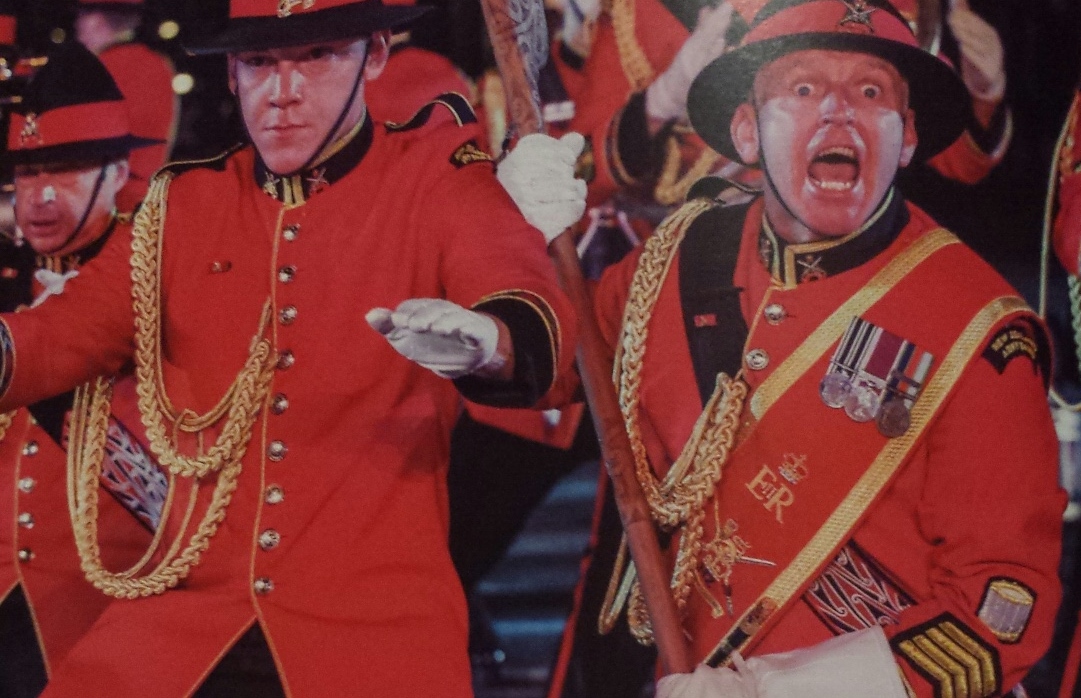
The Royal Edinburgh Military Tattoo in Melbourne - February 2016

Photo Christina Despoteris 2016

I was fortunate enough to go to The Royal Edinburgh Military Tattoo in Melbourne on Sunday 14 February at Etihad Stadium. It was the fifth performance scheduled with a final sixth on Sunday night. Not bad as they had only scheduled two performances to start with. It was captivating from the start.
I had envisaged the roof open but it was shut, obviously Melbourne weather had something to do with it. The replica of the Edinburgh Castle stood tall as a backdrop for the entire performance. It was so realistic that you felt you were in Scotland.
The afternoon performance was very well attended with near a capacity crowd.The special guest for this performance was the Governor of Victoria, the Hon Linda Dessau AM. The Tattoo commenced with a tribute to the Anzacs. That was followed by the Massed Pipes and Drums from Scotland and Australia. 300 of the world's finest pipers and drummers. 
Then there were performances from the groups from New Zealand, Fiji, Tonga and Norway to name a few.
All of the groups were absolutely amazing. Their appearance, the uniforms, the choreography and the whole production was presented with absolute precision and accuracy. I was sitting in the third row from the front, centre left and was amazed at the meticulous presentation of each of the items on the program.All of the groups were applauded very loudly and with enthusiasm, but I must admit the loudest and most energetic applause was for the Australian Defence Force Bands and the South Australian Police Band. Call it patriotism or home soil advantage these two groups stole the show.
Anyone who has watched a Tattoo on television will recall the New Zealand Army Band which is internationally recognised as one of the finest military bands in the world. They don't only sound pitch perfect but they perform some very clever theatre which makes the audiences laugh.
The Band and Drill Team of His Majesty The King of Norway's Guard staged a dazzling musical, marching and drill display.
Switzerland's dynamic percussion ensemble from Basel performed a most enjoyable mix of musical and theatrical display. The finale featured the entire 1,200 strong cast with the Guard of Honour formed by Australia's Federation Guard. They performed the National Anthems of the UK and Australia, followed by Isa Lei, Auld Lang Syne, and then a tribute to personnel currently serving overseas and to the Anzacs who served all those years ago - Sunset and Evening Hymn - 'O' Valiant Hearts and The Lone Piper - After the Battle.
The event concluded with an incredible fireworks display. The Melbourne 2016 event is only the fourth time The Royal Edinburgh Tattoo has left Edinburgh. Over 1,200 performers took part in the event with 30 from Sweden, 45 from Tonga, 50 from Fiji, 110 from New Zealand, 130 from Norway, 285 from the UK and 530 from Australia. 
It took 42 Australian carpenters, painters and labourers to build the full size replica of the Castle and then 70 crew four days to install at Etihad. Around 200 crew worked on each performance. These include lighting, sound, pyrotechnics, wardrobe, back of house, stage managers and props handlers.
This has been the biggest live event in Melbourne since the opening ceremony of the Commonwealth Games.
Australia has been represented at 25 of the 65 Tattoo events in Edinburgh.
Since 1950, the Tattoo has played to more than 13 million audience members in Edinburgh and has been sold out for 17 consecutive years. It is broadcast to 40 countries and watched by around 100 million television viewers.
What does Tattoo mean?
The "Tattoo" takes its name from the cry of inn-keepers in Belgium and the Nederlands over 300 years ago. They ordered "Doe den Tao toe" (turn off the taps) when the pipes and drums of the local regiment marched through the streets signalling the soldiers to return to the barracks.

Extracts from the official program are reproduced below.
 
Christina Despoteris
Vice President
Lemnos Gallipoli Commemorative Committee


Friday, 12 February 2016

Admiral Andrew Browne Cunningham - of Lemnos, Matapan, Greece and Crete - from 1914 to 1941

Admiral Andrew Browne Cuinningham. Photo attributed to Yousuf Karsh. Wiki.
A little known fact is that a number of those who served on Lemnos and in the Gallipoli campaign in 1915 returned to defend Greece and Crete in 1941.
Cunningham and the Battle of Greece and Crete, 1941
One of those was Admiral Andrew Browne Cunningham (affectionately known as "ABC"). The following post is drawn from his memoirs - A Sailor's Odyssey.
Born in Rathmines, Dublin of Scottish heritage, Cunningham was the Royal Navy's Commander-In-Chief Mediterranean during the battle of Greece and Crete in WW2.
He led the Allied naval forces that defeated the Italian Navy in the battle of Cape Matapan, off the Mani peninsula in Southern Greece on the night of 28th-29th March 1941. The Australian Cruiser HMAS Perth and HMAS Stuart took part in this battle. Two Italian destroyers were sunk by Allied destroyers commanded by Captain HML Waller of the HMAS Stuart. Another three Italian cruisers were sunk and the powerful battleship Vittorio Veneto crippled.This engagement effectively destroyed the Italian Navy's surface fleet as an offensive force in the Mediterranean.
Cunningham was also responsible for transport to and the evacuation from Greece - and then Crete - during the subsequent battle for Greece and Crete. During the evacuation - operating without air cover, the Navy suffered many losses. Cunningham was determined that "the navy must not let the army down" and is famously recorded by Winston Churchill as having said in response to Army generals' concern that he would lose too many ships:
"It takes the Navy three years to build a ship. It will take three hundred years to build a tradition. The evacuation will continue."
Cunningham and the Navy's efforts meant that of 22,000 men on Crete, 16,500 were rescued at the loss of three Cruisers and fifteen destroyers. Fifteen other major warships were damaged.
Below are reproduced images from the Australian War Memorial archive showing the battle of Matapan and the evacuation from Greece in 1941.
Battle of Matapan, viewed from HMAS Perth, 1941. AWM
HMAS Perth on patrol Suda Bay, Crete, April 1941. AWM.

Troops evacuated from Greece arrive in Suda Bay, Crete, April 1941. AWM

Troops evacuated from southern Greece, Suda Bay, Crete, April 1941. AWM
Cunningham - Lemnos, Imbros, Tenedos and the Aegean
Yet many are unaware that Cunningham also served in the Aegean in WW1, including taking part in the Gallipoli campaign. He was a highly decorated officer during the First World War, receiving the Distinguished Service Order (DSO) and two bars.
In 1911 he was given command of the destroyer HMS Scorpion, which he commanded throughout the war. In his memoirs, Cunningham described the warship as "one of the latest ocean-going destroyers" - 900 tons, speeds of 27 knots and with one 4 inch, three 12 pounder guns, and two 21 inch torpedo tubes.
Cunningham and the Scorpion was sent to the Mediterranean in November 1913 and stayed there in active service until January 1918.
Between March and the outbreak of war in August 1914, the Scorpion and its flotilla sailed the Ionian, Aegean and the eastern Mediterranean, calling into Corfu, Ithaka and Zante.
With the outbreak of war, Scorpion was involved in the shadowing of the German warships the SMS Goeben and SMS Breslau, both of which managed to evade the Scorpion and the Allied naval force and sail through the Dardanelles to Constantinople.Their arrival contributed to the Ottoman Empire joining the Central Powers in November 1914.
The waters of Tenedos. Photo Jim Claven 2015
During this important action, Cunningham and the Scorpion would often shelter in the waters of Tenedos. Cunningham reports that he and the crew managed to spend some time ashore on Tenedos, and the crew even produced a newspaper, the famous Tenedos Times.
Prior to the formal outbreak of war with the Ottoman Empire, the Scorpion was engaged in naval actions off the port of Vourlah in the Gulf of Smyrne - destroying an Ottoman vessel being converted into a minelayer.
With the declaration of war between the Allies and the Ottoman Empire on 31st October 1914, the Allied fleet - including Cunningham and the Scorpion began patrolling the entrance to the Dardanelles and shelling the Dardanelles forts.
The weather was recorded as very poor, Cunningham writing of the weather around Lemnos and the northern Aegean. In words that resonate with anyone - especially sailors - who have experienced a northern Aegean winter:
"The weather that winter was a sharp surprise to those who had regarded the Aegean as an area of warmth and calm seas. Strong south-westerly winds with a fairly heavy sea nearly always prevailed, though occasionally we had three or four days of north-easterly blizzards with sleet and snow, as bad, and as bitterly cold, as anything I ever saw in the north Sea. it was difficult to keep one's accurate patrol position day and night with visibility of no more than 25 yards, and some destroyers had narrow escapes of running ashore." 
This weather would be visited on the Australian nurses and soldiers who survived a Lemnos winter in 1915/16.
View of ships in Kondia Bay, 1915. AWM
It was during this time that Cunningham and his ship sheltered for 48 hours at Kondia Bay on Lemnos (modern day Diapori Bay near Kontias).
Some days Cunningham's vessel would participate in the shelling of the Dardanelles forts that would last from 9.50 am in morning until sunset. Fishing trawlers re-fitted as minesweepers swept the entrance to the Dardanelles, including around Kephez Point. Landing parties were put ashore during this period to help in the destruction of the forts and gun emplacements. The Scorpion took part in the shelling of Ottoman troops gathered near Morto Bay.
Following the failed Naval attempt to force the Dardanelles in March, the Scorpion sailed into "the fine harbour at Mudros" - Lemnos' Mudros Bay:
"...we got a little more rest in harbour and could occasionally let the boiler fires die out. Fresh food was short, and as often as not we were on "Bare Navy", of which the staple ingredients were bully beef and biscuit."
From March the Allies began assembling the landing forces need for the Gallipoli landings at Lemnos:
"By about the middle of March, 1915, Mudros had become the scene of great activity. though we destroyers did not see much of it. Large transports filled with troops occasionally arriving , and then returning to Egypt to be re-stowed for the assault. Great camps of British, Australian, New Zealand, Indian and French troops were set up on shore."
Cunningham describes the disorganized way materials were assembled - with one ship bringing guns, another ammunition, another vehicles and another machine guns. Everything had to be landed, sorted and re-loaded for the coming landings. These would have best been undertaken at Alexandria, rather than Mudros, with its limited piers and harbour facilities. Meanwhile the destroyers patrolling the Dardanelles could hear "the enemy driving in stakes, putting in barbed wire, and digging trenches, the delay was just asking for trouble."
Following the landings, most of the battleships soon departed the theater for other duties, although some remained at the base at Mudros as a covering force for the Gallipoli campaign as there was still a need for long-range heavy gunfire off the beaches. In August, the Navy would also be engaged in supporting the landings at Suvla Bay.
Shore leave at Imbros. Three Midshipmen set off for an afternoon's picnic, carrying a basket and kettle. Note the ships anchored in the harbour. AWM
The Scorpion and other allied warships patrolled the landing areas, shelling the Ottoman defences, watching for submarine periscopes. The warships spent 48 hours on duty and 48 hours off, many spending their rest in Imbros' Kephalos Bay.
With the evacuation of Gallipoli in early January 1916, Cunningham writes that the Scorpion and the Allied Navy laid a large minefield across the opening of the Dardanelles straits and destroyers patrolled outside it:
"Life was dull indeed. We spent three days on patrol in all sorts of weather, followed by two days coaling and resting at Mudros. after all our months of action and excitement it was a very dreary anti-climax."
As the Allied campaign moved to the Egypt and the Salonika front, the role of the Allied Navy moved to patrolling the Turkish coast from Asia Minor to Syria, to protect Allied shipping from German submarines.
In March 1916, Cunningham and the Scorpion became part of a naval force operating in the Dodecanese, with the forces headquarters at Maltezana (modern Analipsi) on the Island of Astypalea.
Entrance to Vathy harbour, Samos. Photo Jim Claven 2013
In coming months, the Scorpion would sail the waters around Samos, Leros, Kos and Rhodes. Accompanying Cunningham as Intelligence Officer was Lieutenant John Myers RNVR. Myers was a former Professor of Ancient History and an archaeologist who had undertaken excavations on Cyprus, Greece, Crete and Asia Minor:
"...with his many Greek contacts and friends among the local fishermen he was of the greatest assistance to us, though his Greek sympathies by no means made him popular with the Italian governors and officials in the Dodecanese."
The harbour at Rhodes. Photo Jim Claven 2013
Given temporary command of the HMS Rattlesnake, Cunningham was also part of the Allied fleet - mostly French - that assembled at Milos and then sailed into Salamis and Piraeus in September 1916 to seize the Greek Navy and merchant fleet in the harbour.
By October 1916, Cunningham was again in Lemnos' Mudros Bay. One of Lemnos' military uses at the time was as a naval supply base. Cunningham's Rattlesnake and Scorpion both received coal supplies at Lemnos.
Cunningham returned to the Dardanelles patrol in late 1916 and early 1917, which he described as:
"...a soul-destroying occupation neatly out of sight of the coast along which we had steamed with impunity such a short time before."
It was during this time that Cunningham's ship was rammed astern by another Allied warship, the HMS Wolverine. Repairs were carried out at Mudros:
"We limped back to Mudros, where we were temporarily patched up by the repair ship."
For his service during the Dardanelles campaign, Cunningham was promoted to commander and the awarded of the Distinguished Service Order.
A Naval Officer - Across Greece in Two World Wars
Cunningham reflected in his memoirs the curiousness of history:
"I have often reflected how curiously history repeats itself. When I left the Mediterranean as a young commander in 1917 I knew it well. Malta, the Adriatic, Greece, Crete and a multitude of lovely Islands in the Aegean were all old friends. I served in the Mediterranean again between the wars. Little did I imagine how the accumulated knowledge was to be of service to me years later in a position of far greater anxiety and responsibility."
HMAS Scorpion, Valetta Harbour, Malta, 1915.
Lest we forget

Jim Claven
Secretary
Lemnos Gallipoli Commemorative Committee

Sunday, 7 February 2016

Australian Ex-POW Memorial 12th Anniversary Commemorative Service in Ballarat

Mr Mick Moran at left, Mr Bill Rudd (centre) and family, and myself at right. Photo Jim Claven 2016

It was a pleasure to attend the national commemorative service at the Australian Ex-POW's Memorial in Ballarat on Sunday, 7th February.
The Memorial lists all Australian Ex-POW's from the Boer War onwards. It includes recognition of those POW's captured during the battle of Greece and Crete in 1941.
The service was well attended, with many surviving ex-POW's present, senior representatives of all services and local dignitaries. Below are some photographs from the service.
Photo Jim Claven 2016

The many wreaths laid. Photo Jim Claven 2016

The Australian Ex-POW Memorial. Photo Jim Claven 2016
Ms Wright delivering her address. Photo Jim Claven 2016
Mr David Manning addresses the crowd. Photo Jim Claven 2016

Two of the highlights were the address by Ms Paddy Wright (author of Ray Parkin's Odyssey and The Men of the Line) and the recitation by David Manning, a survivor of the sinking of the HMAS Perth and an Ex-POW.
Many wreaths were laid, including by Mr Steve Kyritsis, on behalf of the RSL Hellenic Sub-Branch, who organised a bus-load of attendees for this important event.
Commemorative Booklet. Image Jim Claven 2016

It was also a pleasure to meet up with Mr Bill Rudd, a veteran of El Alamein and Ex-POW, his family and Mr Mick Moran, son of Corporal Henry Moran, a digger who served with the 2/8th AIF Battalion in Greece and Crete in 1941 and was mentioned in dispatches for his service in the Middle East, Greece and Crete, including at the battle of Vevi.
Mr Rudd played a major role in the establishment of the Memorial and continues to assist in verifying the list of POW's honoured at the Memorial. It was announced at the commemorative service that more names had been added and an appeal was made to anyone who had evidence or information supporting the inclusion of other Ex-POW's.
Over lunch, Mr Moran recounted some of his father's memories of the war, including Greece and Crete. Fortunately Henry Moran was recorded on video prior to his passing. Ballarat is the home town of the 2/8th Battalion, the Battalion flag is also on display at the Ballarat Town Hall.
John William Probert's WW2 enlistment photograph. AWM

An Ex-POW of Two World Wars - Elsternwick's John William Probert
Ms Paddy Wright's address included the moving story of John William Probert - an Australia who was unfortunate to have been a prisoner of war in both the First and Second World War.
For those who were unable to attend, the following details I have assembled from Ms Wrights address and the biography of John Probert by Jolyon Horner at the Australian Dictionary of Biography.
John had been born in Elsternwick in Victoria in 1893. He traveled to England, where he enlisted in the Rifle Brigade, arriving in northern France on 23 August 1914. He was wounded and captured at the bloody battle of La Cateau in 1914 - where my own grandfather Private John Dunnion fought with the King's Own Scottish Borderers and was also captured. Held in a POW camp near Berlin, he escaped in 1917 after receiving news that his father was ill. He successfully made his way to england, where he enisted in the Royal Air Force. For his escape, John earned the Military Medal. By war's end, John was commissioned as an officer pilot in the Royal Air Force.
He returned to Australia in 1919 and took up a soldier settlement plot near Rankins Springs in NSW - which as Paddy said lacked water, despite its name! Conditions were very harsh and establishing the farm would be difficult. The stress of the situation led to divorce. Re-married, John finally left the farm in 1938.
A member of the Royal Australian Air Force Reserve in February 1939, John tried to enlist when the Second World War broke out. After various attempts and false starts due to his advanced age (including being temporarily accepted when he under-stated his age!), he was finally accepted under the adopted name of Moule-Probert in April; 1941. A Driver with the 2/15th Field Regiment, John served in Malaya and was sadly captured and eventually shipped to Sandakan. Suffering overwork, starvation, beatings and denied medical supplies, John was one of the more than 2,400 British and Australian POW's who died at Sandakan - only 6 surviving.
In researching John's story, Ms Wright referred to his glamorous looks, captured in the photograph of John as a RAF pilot in WW1, comparing him to Cary Grant!
For more information on the story of John William Probert, see the book Prisoner in Two World Wars - An Australian soldier's story by Sherrif and John Probert.

Lest we forget.

Jim Claven
Secretary
Lemnos Gallipoli Commemorative Committee