Help us promote Lemnos' link to Anzac - Make a donation now

Our Committee is raising funds to create a lasting legacy telling the story of Lemnos' link to Gallipoli and Australia's Anzac story. Our projects include the Lemnos Gallipoli Memorial in Albert Park, the publication of a major new historical and pictorial publication and more. To make a donation you can also deposit directly by direct debit into the Committee's bank account: Account Name: Lemnos Gallipoli Commemorative Committee Inc; Bank: Bendigo Bank; Account No: 188010037; BSB No: 633000; Include your surname in the reference section. For further information on our legacy projects or to make a donation please contact either Lee Tarlamis 0411553009 or Jim Claven 0409402388M

Thursday, 13 April 2017

Kαλό Πάσχα - Happy Easter - from all at the Lemnos Gallipoli Commemorative Committee

Photo: Echo Blue
Wishing all our friends in Australia, Greece and overseas - and especially those on Lemnos - Happy Easter - or as they say in Greece - Kαλό Πάσχα!
At this time we should remember that during Easter in 1915 the Anzac's on Lemnos wrote of being invited to take part in the local Easter services across the Island - experiencing the local Church services and the local Lemnians giving the diggers and nurses traditional red eggs and cakes.
 
A special thank you and Easter wishes to Nikolas Bliatkas and Zanna Kandylidou on Lemnos. If you are visiting Lemnos, make sure that you visit their beautiful Ochra Blue Artspace at P.Kyda 8, 81400 Myrina, Lemnos.For more information about Echo Blue:
F:+302254 026264, 6976220673.
e-mail: ochra.blue13@gmail.com,
http://ochrabl ue.blogspot.gr/, https://www.facebook.com/Ochra Blue

Lee Tarlamis, President
Christina Despoteris, Vice-President
Jim Claven, Secretary 
Lemnos Gallipoli Commemorative Committee

Lemnos Commemorative Events 20-21 April 2017 - Further Information

Photo Jim Claven 2012

Further to our previous post on the planned commemorative events on Lemnos this month (click here for this post), we have been advised by the Lemnos government authorities of more detail on the various events that will occur on Lemnos this month - April 20-21, 2017.
Photo Jim Claven 2015
The program is entitled - "Honor and Memory of the Fallen in the Battle of Gallipoli".
Portianou - 20th April
The events on the 20th April will take place in Portianou, at both the Commonwealth War Grave there and at the Portianou Cultural Centre. Events commence at 4.30pm and conclude after 7pm.
Moudros - 21st April
The events on the 21st April will take place at Mourdos, including at the Commonwealth War Grave there, the Moudros Cultural Centre and at the Anzac Memorial at the Port. Events commence at 9.30am and conclude after 7pm.
Detailed Event Program
A detailed program supplied by the authorities can be viewed and downloaded by clicking
here.
Should you wish to enter the associated "Run for Peace" event, you can download the entry form by clicking here.
Photo Jim Claven 2015

If you are planning to visit Lemnos at this time, we encourage you to attend these important commemorative services. If you are able to attend, our Committee would appreciate copies of any photographs you may take.
Congratulations to Lemnos
Our Committee congratulates the Lemnos authorities and all involved in the coming Commemorative events.
The authorities on Lemnos have organised these events for many years and continue to do so. This is a great honour to the Anzac's and other Allied troops who served there and those who are buried there, as well as the local Lemnians who supported them in 1915 and their families and descendants in Australia and across the world.
Jim Claven
Secretary
Lemnos Gallipili Commemorative Committee


Tuesday, 11 April 2017

You are Invited - Anzac Canal 1941 Presentation - Northcote Town Hall 7pm Thursday 27th April 2017


Anzac Canal Presentation Poster. Created by Paul Sougleris 2017
The 26th April 2017 is the 76th anniversary of the battle of Corinth Canal fought by Australian and other Allied forces at the famous isthmus that separates Greece's central plains and mountains from the great expanse of the Peloponnese.On the 27th April I will be making a presentation - accompanied by archival and contemporary images - telling the story of the Australians at the battle of Corinth and the surrounding region of the Argolid in the Greek campaign of 1941.
The presentation will be held at Northcote Town Hall at 7pm on Thursday 27th April 2017.
The Panargoliki Philanthropic Brotherhood and Pankorithinian Association of Melbourne and Victoria would like to invite all to this important presentation on the part their region played in the Anzac role in the Greek campaign of 1941. Entrance is free.
Corinth Canal. Photo Jim Claven 2016
This region of Greece - containing some of the most famous locations of Ancient Greece - from Mycenae, Argos and Epidavrou - to the first capital of Greece at Nafplio - would witness one of the key battles in the defence of Greece in 1941.
Bell tower, Palamidi Castle, Nafplio. Jim Claven 2013
A focus of my presentation will be the battle of Corinth Canal were Australian soldiers of the 2/6th Battalion - mostly recruited from Melbourne and Victoria - fought a desperate day-long battle against overwhelming German forces. This was the first time that Australian - British and other Commonwealth - troops faced an airborne assault by German paratroops and gliders. The battle of Corinth Canal was a practice-run for the coming assault on Crete in May.
German troops and their supplies descend on Corinth, 26th April 1941
Some of these Victorians would be killed, others wounded and around 200 captured. Others would continue the fight, successfully retreating south to the Allied embarkation beaches across the Peloponnese. Some like Private George Young from Parkdale would be wounded during the retreat and die in captivity.
And a number would be decorated for their bravery that day. Like Captain Henry Dean, a 27 years old farmer from Geelong would be awarded the Military Cross and Private Cyril Coulam, a 35 year old shoe salesman from South Yarra the Military Medal.
And in the hours before the battle, Australian nurses and 33 year old medical officer
Major Edward “Weary” Dunlop from Wangaratta would cross the narrow bridge to safety - waved on by these brave Australian soldiers.
New Zealand troops at Nefplio, awaiting embarkation.
Later Corinth and the region would witness some of the successful embarkations of troops from Greece, the legendary stories of those Allied soldiers who escaped capture by the Germans with the aid of the local people and the sadness of those who would begin their long captivity in the miserable and filthy prison camp established by the Germans at Corinth itself.
And how amazing that many of the descendants of the local residents of the region would make their way to Australia - and to Melbourne and Victoria - from where the diggers of the 2/6th Battalion had sailed all those years ago.
The story of Corinth and the Argolid in 1941 - and the Anzac's who fought there - is in many ways a microcosm of the whole Greek and Crete campaigns of 1941.
An Australian and New Zealand soldier successfully evacuated from the Greek mainland, photographed on their arrival on Crete, April-May 1941. AWM

For more on the battle of Corinth Canal, read my article in Neos Kosmos by clicking here.
To download a copy of the presentation poster, please click here.
The presentation is part of the program of commemorative events for this year organised by the Battle of Crete and the Greek Campaign Commemorative Council - in commemoration of the 76th anniversary of the Greek and Crete campaigns of 1941.
A big thank you to the Panargoliki Philanthropic Brotherhood and Pankorithinian Association of Melbourne and Victoria for organising and sponsoring this important event.


Jim Claven
Secretary, Lemnos Gallipoli Commemorative Committee
Member, Battle of Crete and the Greek Campaign Commemorative Council

Saturday, 8 April 2017

You're Invited - Lemnos Honoured on Anzac Day in Melbourne 2017

Oakleigh Cenotaph, re-dedicated by Lieutenant-General Sir Ned Herring who served in Greece in both world wars. Photo Jim Claven
Across Melbourne and Australia thousands of RSL's and communities will participate in Anzac Day ceremonies. This is to advise that our Committee has been formally invited to participate in two Anzac Day ceremonies in 2017.
Arlene Bennett as the Nurses Memorioal Centre memorial to nurses who served and suffered in war. Photo Jim Claven
Nurses Memorial Centre
Melbourne's Nurse Memorial Centre will be holding its annual Anzac Commemorative Service on Sunday, 23rd April 2017 at 2pm. The service will be held at the Centre - Suite 11, Fawkner Towers, 431 St Kilda Road, Melbourne. The Service will to honour Victorian and other nurses who have made sacrifices of life and health, both in times of peace and war.
It is particularly relevant for our Committee to participate in this service given the role of Australia's nurses on Lemnos during the Gallipoli campaign, many of whom were exposed to disease and illness during their service. And also because of the support of the Nurses Memorial Centre for our various projects, including the Lemnos Gallipoli Memorial in Albert Park.
Our President will lay a wreath during the service.
This Service will be followed by a presentation by one of our Committee members (and Board member of the Nurses Memorial Centre) on her recent visit to Banka Island and the memorial service held there for the Australian nurses murdered there by Japanese forces in 1942.
All are welcome to attend the Oakleigh-Carnegie Dawn Service. It would be great to see a good turn-out of our Committee at this event.
Oakleigh Dawn Service and Breakfast
The Oakleigh-Carnegie RSL in Drummond Street, Oakleigh, will hold its traditional dawn service at 6am on 25th April 2017.
Our President, Mr Lee Tarlamis, will lay a wreath on our behalf. This is particularly poignant in Oakleigh for two main reasons.
Firstly, Private William Withers is one of the diggers who served in the Gallipoli campaign who tragically died and is buried on Lemnos. He and his family are connected to Oakleigh. After representation by myself on behalf of the Committee is name has been added to the Oakleigh-Carnegie RSL Honour Board.
Secondly, the Oakleigh Cenotaph was re-dedicated by Lieutenant-General Sir Ned Herring, an Australian artillery officer who served on both the Salonika Front in the First World War and in Greece during the campaign there during the Second World War.
Oakleigh's William Withers, his grave on Lemnos. Photo Jim Claven
All are welcome to attend the Oakleigh-Carnegie Dawn Service. It would be great to see a good turn-out of our Committee at this event.
You can read more about William Withers and Oakleigh from my previous Anzac Dawn Service address at Oakleigh in 2014 by clicking here.
Mr Tony Tsourdalakis will also lay a wreath, on behalf of the Melbourne-based Battle of Crete and the Greek Campaign Commemorative Council, in recognition of the role of local diggers in those campaigns in 1941. Melbourne's Anzac Day Parade
A number of members of Melbourne's Greek-Australian community will join with the veterans and descendants of Australia's 6th Division diggers who served in the Greek campaign in 1941 during Melbourne's Anzac Day parade.
If you would like to meet some of these veterans and descendants, they will assemble to the eastern side of St Paul's Cathedral on Flinders Street, prior to marching off at 9.45am.
Below are some photos of last years parade, showing members of Melbourne's Cretan community with the 2/7th Australian Infantry Battalion Association. 
 

Jim Claven
Secretary, Lemnos Gallipoli Commemorative Committee
Member, Battle of Crete and the Greek Campaign Commemorative Council
 

Wednesday, 5 April 2017

Anzac Commemorative Service - Caulfield Hospital (Formerly No 11 Australian General Hospital and Repatriation Hospital) - 2pm 24th April 2017

Caulfield Hospital Memorial stone, Anzac Service 2014, Courtesy of Nelson Brothers Funerals Facebook page 6 April 2017
It has come to our attention that Caulfield Hospital will hold its annual commemorative service at 2pm, Monday, 24th April. The service will take place near the front gates, in front of the memorial stone, at the hospital, 260 Kooyong Road, Caulfield.
Caulfield Hospital was formerly known as No. 11 Australian General Hospital (AGH) or later the Caulfield Repatriation Hospital. The original "Glen Eira" mansion (built in 1865) was purchased by the Department of Defence in 1915 and from 1916 opened its doors to treat injured and disabled soldiers from WWI. The hospital was renamed Caulfield Hospital in 1959. The Hospital has continued to maintain this strong link with the veteran community.
In 1966 a history of the hospital was published titled "The wounded warrior and rehabilitation: including the history of no. 11 Army General Hospital - Caulfield Rehabilitation Hospital". This was published by The Alfred Healthcare Group [Caulfield general Medical Centre] The book was written by Bruce Ford, a former Medical Director of Caulfield Hospital. Sadly the book has been long out-of-print but moves are afoot to possibly re-publish this important addition to our Anzac literature and history.
Lemnos Connection - Albert Jacka
No doubt many of the diggers who fought at Gallipoli and walked on Lemnos were given care at the Hospital after they returned from the war.
One of these was Captain Albert Jacka, who died at the Hospital, succumbing to the effects of his many war injuries, after collapsing duyring the St Kilda City Council meeting on 17 January 1932. Albert had come to Lemnos during the Gallipoli campaign on a number of occasions, incluyding when ill. He was famously photographed on the Island in 1915. He was also paraded before visiting military dignitaries after his being awarded Australia's first Victoria Cross of the war.
You are Invited
With its grand military history as a Repatriation Hospital, Caulfield Hospital holds an annual ANZAC Service next to their Memorial Stone in the gardens of the hospital.The event is attended by local councillors & MPs, representatives of the Caulfield RSL, and patients and staff of the hospital and nursing home. It is a moving ANZAC Service with recitations and bugler. All are welcome to attend.
Images from the past
To illustrate No. 11 Australian General Hospital (AGH)'s important role in Australia's veteran and nursing history, below are some photographs of the Hospital held in the archives of the Museum of Victoria


The last image is that of a magazine - The Caulfield Cripple - produced as a souvenir Anzac Day Edition in 25 Apr 1917. It was produced to commemorate the second anniversary of the Anzac forces' landing in Gallipoli. It contains contributions from present and past hospital patients and staff members, including articles, poems and correspondence.
The following images of the Hospitals Memorial stone were taken by Georgia Pernitzis.


Thanks to George Pernitzis for letting me know about this service and to the Museum of Victoria, Glen Eira Rotary and Nelson Brothers Funeral Services for making some of this information available on-line.

Jim Claven
Secretary
Lemnos Gallipoli Commemorative Commitee


Tuesday, 4 April 2017

Lemnos or Salonika? Australian nurses and soldiers rest by the bay

Lemnos or Salonika?

This famous image of diggers and nurses in Greece during the First World War is emblematic of the experience of the Anzacs in Greece. Over 50,000 Australians came to Greece in the war, the vast majority serving on Lemnos (and the nearby then-Greek held Islands of Imbros and Tenedos), with others serving on the Salonika Front, centred around modern day Thessaloniki.

The image features on Professor Bruce Scates' great novel about the Gallipoli campaign - On Dangerous Ground:

However the official title of this image is however wrong. The Australian War Memorial records that it was taken in "Salonika" and depicts:

"View of the 60th British General Hospital. Note the large Red Cross in the centreground. This is the centre image in a three part panorama."

The first thing to say about this is that this is not a view of the 60th British General Hospital and there is no Red Cross in the centre ground. Also there were very few diggers on the Salonika front, and these only for a few weeks around late 1915 and early 1916.

The AWM archive states that the image is part of a three part panorama - and indeed two other images connected to it are of the 60th British General Hospital at Salonika (A02205A and A02205C). But sadly the third photo (A02205B) has been misplaced and this photo archived incorrectly.

It is in fact clearly the view from near the Australian hospitals on Lemnos' Turks Head peninsula, looking across the small cove to the west in the foreground, with the causeway leading to the small Greek Orthodox church - Agios Nikolaos (if I am not mistaken) - jutting into Mudros Bay - a causeway and the church that stand to this day.

Below is one of my photos of the church and causeway, taken in the centenary year of 2015, when I took the descendants of Brisbane's Matron Grace Wilson, on a personal tour of the area. The photo below was taken from a position not far from that wear the diggers and nurses sat in 1915.
  

I have sent a submission to the Australian War Memorial of the need to correct the title of this photograph.

 Jim Claven
Secretary
Lemnos Gallipoli Commemorative Committee

Sunday, 2 April 2017

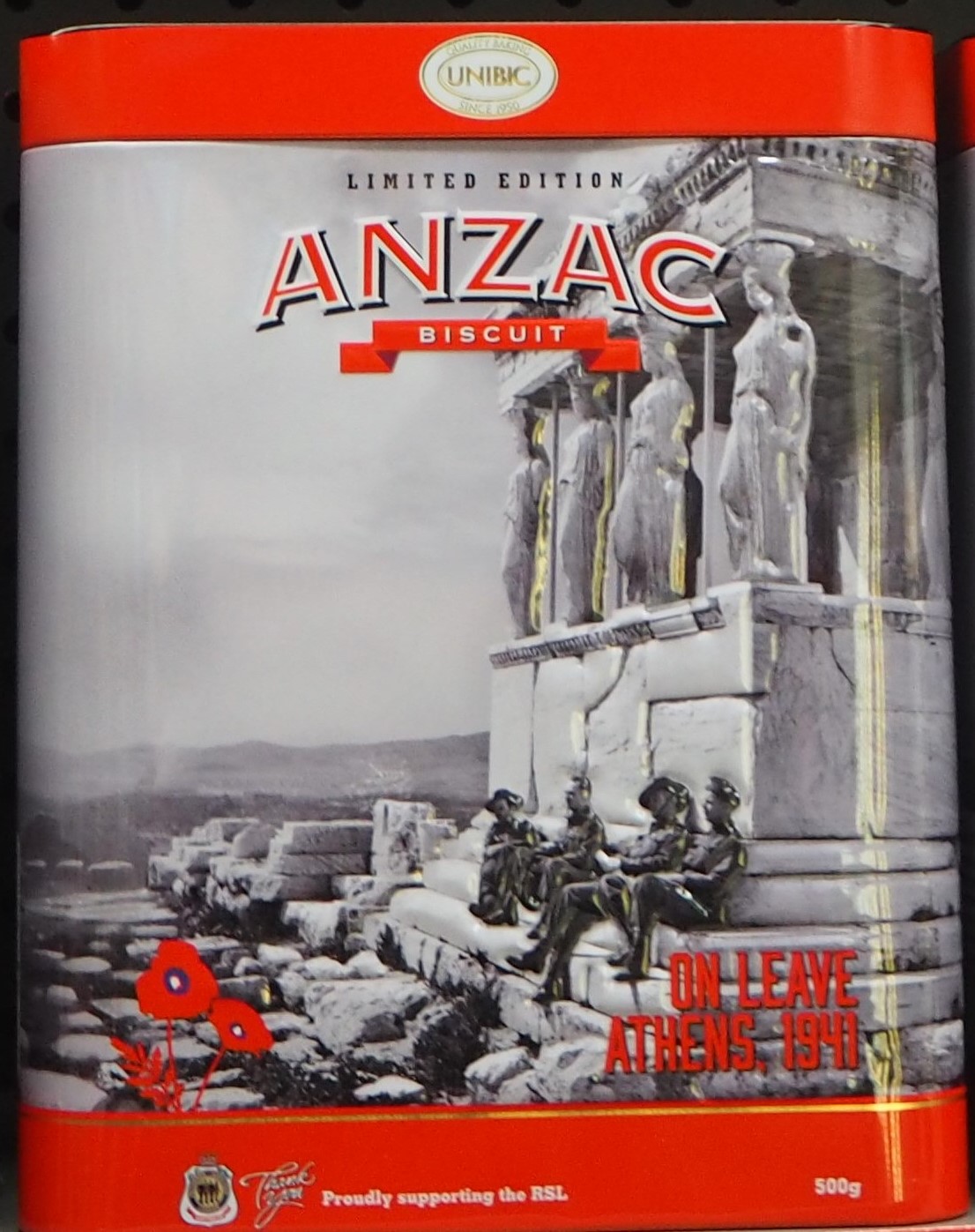
Out Now! - Anzac Biscuit Commemorative Tins Honour the Anzacs in the Greek and Crete Campaigns of 1941


Anzac Biscuit Commemorative Tin. Photo Jim Claven 2017
An iconic image of Australian diggers on the Acropolis in early 1941 will feature on the UNIBIC Commemorative Anzac Biscuit Tin. These tins – which contain Anzac biscuits - are produced by UNIBIC with proceeds going to the RSL to support its work assisting veterans and their families.
Each edition of the tin is adorned with a historic image from Australia's ANZAC legend. This is the first time that an image from the Greece and Crete campaigns has featured on the tins. The initiative is the result of a proposal from Mr Tony Tsourdalakis on behalf of the Battle of Crete and the Greek campaign Commemorative Council.
The Anzac Biscuit Tins help raise awareness of the Anzac involvement in the Greek and Crete campaign of 1941. Photo Jim Claven 2017

Mr Tsourdalakis, who is Secretary of the Council, said that it was a great honour to have Greece and its connection to Anzac chosen to feature on this year’s commemorative tin.It will bring the story of the Anzacs in Greece to thousands of homes across Australia. What a great gift for your friends and loved ones!
Anzacs on the Acropolis. AWM
The image is one of the most iconic photographs of the Australian involvement in the Greek campaign held in the Australian War Memorial in Canberra.
It shows diggers on the Acropolis, resting beneath the famous Caryatids of the Erechtheion. It symbolizes the experience of Greece and its culture by the thousands of Australian soldiers and nurses during the campaign in Greece and Crete. Soon these relaxing diggers sitting on the Acropolis would move north to join with Greek and other Allied troops to face the looming German invasion of Greece.
Photo Jim Claven 2015
The image is so famous that it was used by the Australian Government to promote the 70th anniversary of the Battle of Greece and Crete in 2011.
Poster produced by the Australian Department of Veterans Affairs, 2001

For all those interested in the Hellenic link to Anzac - go out now and buy yourself one of these iconic tins before they sell out!
The Tins can currently be purchased at major IGA supermarkets but should be available from other outlets in the future.
Hopefully we will have more iconic images from the Hellenic link to Anzac on the tins in the future!
Well done to Tony and all involved in the Battle of Crete and the Greek Campaign Commemorative Council.
Jim Claven
Secretary, Lemnos Gallipoli Commemorative Committee
Member, Battle of Crete and the Greek Campaign Commemorative Council