Help us promote Lemnos' link to Anzac - Make a donation now

Our Committee is raising funds to create a lasting legacy telling the story of Lemnos' link to Gallipoli and Australia's Anzac story. Our projects include the Lemnos Gallipoli Memorial in Albert Park, the publication of a major new historical and pictorial publication and more. To make a donation you can also deposit directly by direct debit into the Committee's bank account: Account Name: Lemnos Gallipoli Commemorative Committee Inc; Bank: Bendigo Bank; Account No: 188010037; BSB No: 633000; Include your surname in the reference section. For further information on our legacy projects or to make a donation please contact either Lee Tarlamis 0411553009 or Jim Claven 0409402388M

Saturday, 4 April 2020

Lemnos Contrasts - A Diggers Memories - 1935

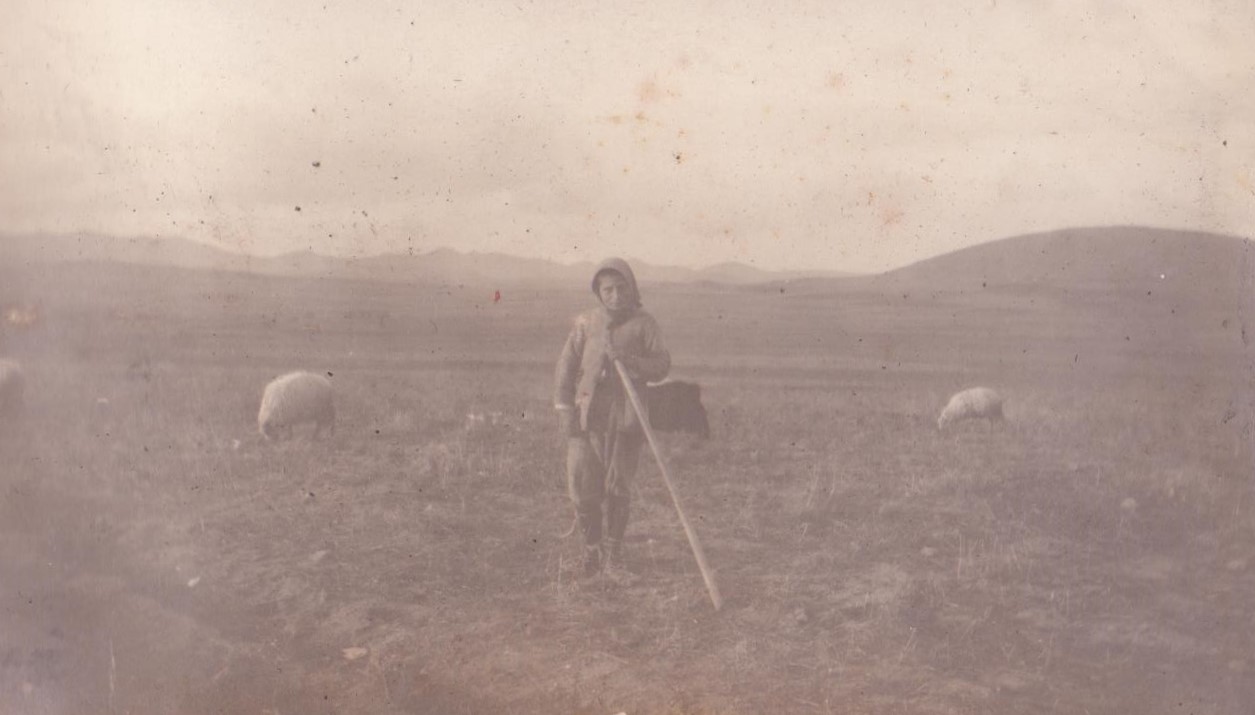
A young shepherd on Lemnos, 1915-16. Staff Nurse Evelyn Hutt Collection, State Library of Victoria

The following account by an unnamed Australian soldier who served on Lemnos during the Gallipoli campaign was published in 1935.

"A recent paragraph in "Smith's" about Lemnos Island recalls to my mind a day spent on the Mudros side of the harbor. The narrow streets of Mudros were thronged with Australians, Tommies, New Zealanders, French, Indians, Ghurkas, and Senegalese from the camps. 
Nearby was a Turkish prisoners' camp. On the waterfront and the harbor all was bustle and activity. Boats and troops were coming and going, stores were being landed, G.S. wagons churning up the dust. And then the contrast. 
A half-hour's walk took my cobber and me into the hills. What a change! Not a sight or sound of the activity left behind. A tortoise flops into a pool at our approach. The only sound to be heard was the tinkle of bells from a flock of sheep on the hillside, the shepherd, with his staff, standing motionless. 
In the near distance was a village, marked by windmills with the sails set, while beyond, across the beautiful blue of the Aegean, a small Island showed out under a cloudless sky. My cobber and I were both Impressed by the beauty and quietness of the scene, and he said: "You wouldn't think there was a war on!" - "91.""

From Smith's Weekly, Saturday 27 April 1935
 
Windmill on Lemnos, 1915-16. Staff Nurse Evelyn Hutt Collection, State Library of Victoria

This is reminiscent of the photographs show here from the Staff Nurse Evelyn Hutt collection held by the State Library of Victoria and the accounts recorded by an another digger in his private diary - Private Henry Gissing of 1st Field Ambulance. Henry also wrote of seeing Turkish prisoners near the pier where he landed at Mudros on 10th Arpil, the next day recording the presence of French soldiers at Mudros, with whom he shared a drink or two! On 21st June Henry wrote of watching sheep at Mudros and on the 14th and 15th October of walking into the hills behind Mudros and described the scene in not dissimilar terms.

Just another story from Australia's Lemnos archive.

Jim Claven
Secretary, Lemnos Gallipoli Commemorative Committee


Tuesday, 17 March 2020

Urgent - Anzac Commemorations in Greece Cancelled

East Mudros Military Cemetery, Lemnos. Photo Jim Claven

The Lemnos Gallipoli Commemorative Committee has been informed that due to the COVID-19 virus the planned Gallipoli commemorations scheduled for April 2020 will not long be held. This is consistent with not only Greek Government advice regarding the holding of public events at this time. Although we have not been able to confirm the situation with the Australian Embassy in Athens, it can be expected that the Anzac Day commemorations, held every 25th April at Phaleron War Cemetery in Athens, will also not be held this year. It can also be assumed that other public Anzac commemorations planned for other parts of Greece - such as Crete - will also not be held as public events.
Those seeking further information should contact the relevant local authorities in Greece.

Although this is disappointing to those wishing to take part in these commemorations, it is entirely understandable and appropriate in the circumstances. A similar approach is being taken in Australia regarding Anzac Day commemorations.

We look forward to the Anzac commemorations which will take place in April-May 2021, which coincides with the 80th anniversary of the Greek campaign of 1941. Hope to see you all there.

Lemnos Gallipoli Memorial, Lemnos Square, Albert Park. Photo Jim Claven

We also hope that we will be able to hold our annual Lemnos Gallipoli service at our Lemnos Gallipoli Memorial in Lemnos Square, Albert Park on 8th August - as well as the Armistice of Mudros commemoration at the Shrine of Remembrance on 31st October - latest this year - COVID-19 situation permitting.

Jim Claven
Secretary, Lemnos Gallipoli Commemorative Committee

Tuesday, 3 March 2020

Push by Lemnos Gallipoli Commemorative Committee for recognition of WW1 Lemnos service with Gallipoli Medallion

Gallipoli Medallion. Australian Defence Department
One of the major oversights of Australia’s commemoration of the Gallipoli campaign is now formerly under review by the Australian Government – the eligibility of those who served on Lemnos (as well as the adjacent Islands of Imbros and Tenedos and the surrounding sea) for the Gallipoli Medallion. The Gallipoli Medallion was instituted in 1967 by the then Australian Government led by Harold Holt to Gallipoli veterans or the descendents of those who had since passed. The award consisted of a medallion and a small matching lapel badge, the former pictured here. My research revealed that eligibility was restricted to those who had served in direct support of the operations of the campaign at Gallipoli and in a defined geographic area of the campaign.
To my amazement this area was limited to the land masses to the north and south of the Dardanelles and the immediate waters. The area specifically excludes the nearby Islands of Lemnos, Imbros and Tenedos as well as the waters surrounding these areas. These Islands and the waters surrounding them played a major role in the Gallipoli campaign, providing direct and essential support to the troops serving on the Peninsula.
View of the Island of Imbros, where Charles Bean and other Anzacs walked in 1915. Photo Jim Claven 2015
As my research has shown Lemnos was the major advanced base for the Gallipoli campaign, its large and protected harbor providing a safe haven to the tens of thousands of troops who came there as they travelled to and from the battlefields of the Peninsula. The Island was home to major supply bases, medical facilities and other important infrastructure. Almost every soldier who served at Gallipoli served part of his time on Lemnos.
Southland Memorial publication
The other Islands of Imbros and Tenedos as played key roles in the campaign. Imbros was the main harbor close to the fronts at Anzac Cove and Suvla Bay, acting as a transit hub, there were medical facilities, supply depots and headquarters. Tenedos was major naval and air base, as well as being a transshipping hub for troops headed for the southern front at Helles. And through the waters surrounding these Islands stretching to Gallipoli, troopships and hospital ships made there way. It would be true to say that without the direct support of the troops and other units serving in these Islands and waters, the Gallipoli campaign could not have taken place.
Colonel Linton grave, East Mudros Military Cemetery, Lemnos. Photo Jim Claven
And these were dangerous locations to be based. Proximity to the Gallipoli battlefront meant being subject to enemy air, submarine and torpedo attacks. Lemnos was subjected to numerous enemy air attacks, one resulting in the deaths of many soldiers, with bombs being dropped close to Australian medical facilities on the Island. By far the greatest danger was at sea. Many Allied ships were attacked, damaged and sunk, with consequent loss of life, in the waters off Gallipoli. The most well-known Australian example was the attack on the troopship Southland on 3 August 1915 as it headed to Lemnos with reinforcements for the August Offensives. This resulted in thirty-two Australian deaths, including that of 54 year old Colonel Richard Linton, commander of the 6th Australian infantry Brigade. Those bodies that were found were buried on Lemnos, others being memorialized on the great commemorative edifices on the Peninsula.
Private Jones grave, East Mudros Military Cemetery, Lemnos. Photo Jim Claven
Hundreds of Australian soldiers became all and a number died at Lemnos on their way to Gallipoli, some from the illnesses that plagued the troopships, others in training accidents. One of the former was 29 year old Private Alexander Jones who never made it Gallipoli, having died of pneumonia and was buried on Lemnos. Indeed, many of those based on Lemnos were subjected to the ravages of disease, some brought with the ill soldiers, many having to be repatriated. It was due to illness that two Canadian nurses died on Lemnos, the only nurses to die during the campaign. Surely this suffering stands testimony to the bravery of the service of those on Lemnos, the other Islands and in the disease-ridden ships transporting the wounded and ill from Gallipoli.
Australian nurses arrive on Lemnos, August 1915. Photo Albert Savage Collection, State Library of NSW
It is my contention that all of the Australian personnel who served on the northern Aegean Islands mentioned or in the waters nearby deserve to be included in the criteria for the Gallipoli Medallion. What better way to recognize the service of the medical staff on Lemnos, including the many nurses such as Matron Grace Wilson and Staff Nurse Evelyn Hutt. And those who died – like Colonel Linton from Brighton in Victoria - as part of their service during the Gallipoli campaign.
Last year it was my pleasure to prepare a submission for the Lemnos Gallipoli Commemorative Committee proposing a review of the eligibility criteria for the Gallipoli Medallion in order that service on Lemnos, Imbros, Tenedos and on the ships sailing in the adjacent waters be incorporated to the eligibility criteria as an amendment to the defined area. Recently the Australian Minister for Veterans Affairs informed the Committee that he had referred the matter to the Department of Defence for formal review.
Colonel (Ret) Jan McCarthy OAM RRC, President of the Nurses RSL Sub-Branch said that nursing service personnel had long sought the expansion of the criteria as proposed and supported the Committee’s initiative. “The nurses who served on Lemnos and on the hospital ships that sailed the dangerous waters of the northern Aegean deserve no less,” she added.
The President of the Lemnos Gallipoli Commemorative Committee, Mr Lee Tarlamis OAM, stated that the Committee was keen to pursue this issue of recognition and welcomed the news that the Australian Government had placed the proposal under review. “The Committee is ready and willing to provide any documentary evidence to the review that might be required,” he added.
It is anticipated that the review should be completed by the end of 2020.

Jim Claven
Secretary
Lemnos Gallipoli Commemorative Committee
Wednesday, 19 February 2020

Lemnos Gallipoli Tour - 22nd April 2020

Jim Claven at the unveiling of the nurses memorial at Portianos Military Cemetery in April 2015. Photo Jim Claven 2015

Jim Claven will be leading a small group guided tour of Lemnos and its Anzac-related sites in April 2020.
The tour is planned to take place on 22nd April, following the formal Gallipoli campaign commemorations that will be held on Lemnos on the preceding 20th and 21st April.
The tour will take in the major sites of East and West Mudros, including the Allied war cemeteries, the Turks Head Peninsula, Therma and some of the various villages connected to the Allied presence on Lemnos during the campaign. There will be an opportunity for  refreshments in a local village, completed with a final dinner at Myrina.
You can download Jim Claven's Lemnos Gallipoli Tour brochure by clicking here.
Tour Leader - Jim Claven, MA
As many will know, Jim is a historian and freelance writer who has studied Lemnos’ role in Australia’s Anzac story for many years, combining academic research with extensive field trips to the sites connected with the Anzacs on Lemnos, Imbros, Tenedos as well as Gallipoli itself and beyond.
Jim Claven (left) on his tour of Lemnos in 2015 with descendants of Matron Grace Wilson on Lemnos' Turks Head Peninsula, April 2015. Photo Jim Claven 2015
Jim's tour of Lemnos in 2018, with Deb Stewart (left, descendant of Staff Nurse Evelyn Hutt) and Lee Tarlamis OAM (second from right, descendant of Private Ted Tozer) at the Therma baths. Photo Jim Claven 2018.

Holding Bachelor and Masters degrees from Australia’s Monash University, Jim Claven has researched the story in the archives held in Australia and overseas. He has walked the ground where the Anzacs stood in 1915-16. His extensive research led to the identification and commemoration in 2018 of the Australian Pier on Lemnos, the pier having been originally erected by Australian soldiers in 1915. He is the author of many articles on the connection between Australian and Lemnos through the Anzac story (including in the Melbourne Shrine's Remembrance magazine, the State Library of Victoria’s La Trobe Journal, the UK's Gallipolian and that of the Hellenic Navy in Greece).
He has delivered many presentations on the topic, both in Australia and in Greece.
He has curated the Lemnos Gallipoli Commemorative Committee’s Photographic Exhibition – Lemnos and Gallipoli: A Story in Pictures - showcasing 40 of the best photographs taken from the archives in Australia and overseas - along with its accompanying exhibition booklet. This exhibition has been displayed in Greece (at the Athens War Museum and on Lemnos) as well as across Australia (including at the Victorian State Parliament).


He is also the author of the recent publication – Lemmos & Gallipoli Revealed: A Pictorial History of the Anzacs in the Aegean 1915-16 – published by Australia’s Lemnos Gallipoli Commemorative Committee, of which Jim has been the Secretary since its foundation in 2011.
Register Now
If you are interested in joining Jim on this personal, small group tour of Lemnos, please contact him for information or to register directly via email - jimclaven@yahoo.com.au - or on 0409402388 - by the end of March 2020.

Sunset over Lemnos' Mudros Bay, with the Turks Head Peninsula in the middle distance. Photo Jim Claven 2015