Help us promote Lemnos' link to Anzac - Make a donation now

Our Committee is raising funds to create a lasting legacy telling the story of Lemnos' link to Gallipoli and Australia's Anzac story. Our projects include the Lemnos Gallipoli Memorial in Albert Park, the publication of a major new historical and pictorial publication and more. To make a donation you can also deposit directly by direct debit into the Committee's bank account: Account Name: Lemnos Gallipoli Commemorative Committee Inc; Bank: Bendigo Bank; Account No: 188010037; BSB No: 633000; Include your surname in the reference section. For further information on our legacy projects or to make a donation please contact either Lee Tarlamis 0411553009 or Jim Claven 0409402388M

Sunday, 25 October 2015

Lemnos Hero - Lance Corporal William Lycett's Great War Diary - Moonee Valley Leader

Above is a report from the Moonee Valley Leader, Wednesday 14 October 2015, telling some of the story of Lance Corporal William Lycett's connection to Lemnos in 1915.


Great War Diary of 2063 Lance Corporal William Dalton Lycett served with the 4th Field Ambulance AIF & 15th Australian Light Railway Operating Company in the First World War.
I have read the full dairy and it contains many more detailed references of his time on Lemnos - in April before the landings, September through October and after the evacuation of the peninsula in December.
William appears to have had a good time on Lemnos - seeing the Island, visiting Therma, buying fresh food from the locals. He records visits to the Australian hospitals on Lemnos. 
Here is an excerpt from his diary for Monday, 18th October:

"After breakfast set out for No. 3 General Hospital to see dentist, great crowd waiting to see him or them. Waited about 2 hours and then succeeded in getting an appointment for Monday next at 2.15 p.m. Left No. 3 General Hospital and went with a pal to see a friend of his who is sick in No. 2 Stationary Hospital. Stayed talking to him till 12 midday, the hospital he was in was splendid and clean and patients all looked contented. Spoke to sister in charge of ward, practically first woman spoke to since leaving Melbourne 10 months."


Thanks Executive member, Arlene Bennett, for providing this article.

Jim Claven
Secretary
Lemnos Gallipoli Commemorative Committee

Friday, 23 October 2015

The Salonica Front in World War 1 - Major International Academic Conference Held 22nd-24th October 2015

In this the Centenary year of the outbreak of World War 1, the Aristotle University of Thessaloniki, the University of Macedonia and the Institute for Balkan Studies, in association with the Consulate-General of France in Thessaloniki, are organizing an International Conference under the auspices of the Municipality of Thessaloniki.
The Conference - “The Salonica Front in World War I” aims to highlight the importance of the Salonica Front in the wider military context of the war.
The Coference will be held on Thursday 22 October - Saturday 24 October.
The Conference will commence at 6.00 pm on Thursday 22 October and will be held at the Ceremony Hall, University of Macedonia and will be chaired by Ioannis Mourelos. The key note address will be given by Sir Hew Strachan - "1915, the search for solutions". The next speaker will be Georges-Henri Soutou and he will be followed by a Musical Concert.
The Conference will then move to the Aristotle University of Thessaloniki for the remainder of the Conference.
There will be two themes covered during the second day:
1.   Strategic planning and political perspectives
2.   Military operations
The first session on Friday morning, chaired by Sir Hew Strachan will be by Spyridon Sfetas and will be titled: “From Gallipoli to Thessaloniki: The legacy of the Greco-Serbian Alliance, the Bulgarian factor and the formation of the Salonica Front, 1915-1916”Other prominent speakers during the day will include Konstantinos Ailianos, Richard Hall, Vlasis Vlasidis, Claude Carlier, Holger Afflerbach to name a few.
The sessions on Friday are:
1.   Aspects of war and the treatment of memory
2.   After the war
They include: Iakovos Michailidis - “War correspondents at the Macedonian Front”,
Roumen Genov - “The Salonica Front and the Bulgarian Public Opinion” and Alexandros Garyfallos, Dimitrios Christodoulou, Paraskeuas Savaidis - "Medical services in the Macedonian Front: evacuation, hospitalization  and repatriation of the sick and wounded" to name a few.

Below is a summary of Spyridon Sfetas' paper on "From Gallipoli to Salonica : The legacy of the Greco-Serbian Alliance, the Bulgarian factor and the formation of the Salonica Front 1915- 1916"

"At the beginning of 1915 the Entente Powers drifted to the adventure of the Dardanelles operations  and the Kallipolis campaign. . They suffered a tremendous disaster. .The Entente Powers believed that the Great War would be decided not in the Balkans, but in Western Front. They tried again to win over Bulgaria by promising territorial gains in Macedonia  after the war if Greece and Serbia secured adequate  compensations in Asia Minor and Bosnia  respectively. When in  September 1915 Bulgaria joined the Central Powers, Venizelos opted for Greece’s siding with the Entente. Since Bulgaria and Turkey had already sided with the Central Powers, Greece had no alternative but to join the Entente to fulfill its territorial claims in Asia Minor. Serbia’s collapse would open the way from Berlin to Constantinople since Bulgaria would  immediately invade Serbia He argued that Bulgaria’s aggrandizement at the expense of Serbia and Serbia’s destruction would  destroy the Balkan  equilibrium and endanger Greece’s position. It was therefore to Greece’s interest to take advantage of the situation to attack Bulgaria independently of Greece’s alliance obligations to Serbia.  He now requested the Allies to send 150, 000  men  to Salonica i.e., the forces which Serbia would have to deploy against Bulgaria according to the military convention. Greece’s neutrality was not tenable any more. Germany proved to be  unable   to protect the Greeks  in Asia  Minor from the atrocities of the Turks and  to oppose Bulgarian territorial  claims on Greek part of Macedonia as a counterweight for Greece’s neutrality. The Bulgarian- Macedonian lobby and the Internal Macedonian Revolutionary Organization (I.M.R.O), calling for a conclusive solution of the Macedonian Question, were  active in Bulgaria and kept in touch with German agents.  Germany’s war propaganda was rampant in Greece. Baron Schenk  bribed  the  main Greek newspapers. At any rate Greece’s national interests and not merely the myrhologized Greco- Serbian  Treaty of Alliance dictated Greece’s siding with the Entente..Greece experienced a national split, and Serbia was destroyed."

For a full report on the Conference, please click here.

Christina Despoteris
Vice President
Lemnos Gallipoli Commemorative Committee

OHI Day 75th Anniversary commemoration in Melbourne and Sydney - Wednesday 28th October 2015

OHI Day commemorates the valiant resistance of Greece to the Italian invasion of 1940 and  the subsequent resistance to the German invasion and occupation of Greece in 1941.

The word OHI meaning "No" were the words shouted by the Greek people in the streets in response to the Greek Government's rejection of the ultimatum of Italian dictator Benito Mussolini on 28th October 1940.  28th October has been celebrated as OHI Day since 1942 and is celebrated throughout Greece, Cyprus and Greek communities across the world. In Australia it is a day to commemorate Greece's resistance to the Axis powers in WW2 as well as the role of the Second Anzacs who came to defend Greece in 1941.
Over 17,000 Australians and nearly 17,000 New Zealanders took part in the campaign in Greece - 172 Australians and 215 New Zealanders are buried at the Commonwealth Military Cemetery in Athens (Phaleron) and a further 140 Australians and 343 New Zealanders at the Commonwealth Military Cemetery on Crete (Suda Bay). Both pictures above show Australian diggers discover the Acropolis during their brief stay in Athens on their way to the front (AWM).
One of these was GunnerJames Zampelis (photo above AWM), a digger of Hellenic background, who was killed during the battle of Crete - the only Hellenic background Anzac to die and be buried in Greece in WW2. Born in Melbourne, James' father was born on the Greek Island of Lefkada. He was buried near where he fell, at the Cretan village of Mournes. After the war his grave could not be located. He is honoured on the memorial to the missing at Phaleron (Photo below - Jim Claven 2013). We remember him on 28th October 2015 along with the other Anzacs who served with him in Greece and Crete in 1941.

An estimated 4-5,500 Allied soldiers who escaped capture were supported by the Greek community throughout the years of the Axis occupation of Greece (1941-44) at great risk to their lives. OHI Day is a special day to honour the Anzacs of the Greek campaign and their Greek comrades and supporters.

Details of the commemorations to be held in Melbourne and Sydney this coming Wednesday 28th October 2015 are set out below.
All interested in commemorating this important day of remembrance are welcome.

OHI Day Commemoration in Melbourne

The RSL Hellenic Sub-Branch have advised that they will be holding OHI Day commemorations in Melbourne on Wednesday 28th October 2015 as follows:

12 noon - Wreath laying at the Australian Hellenic Memorial, Domain Gardens
1.00pm - Wreath laying ceremony at the Shrine of Remembrance

OHI Day Commemoration in Sydney

The following communication has been received from the Sydney-based Joint Committee for the Commemoration of the Battle of Crete & The Greek Campaign in Sydney. If you are able to attend please do so.

Dear Friends and Admirers of the Hellenistic Spirit!


NO ( OHI ) DAY 28th October 2015 - 75th Anniversary

The Consul General of Greece , Dr. Stavros KYRIMIS in conjunction with the Joint Committee for the Commemoration of the Battle of Crete and the Greek Campaign invite you ALL to the Public Flag Raising and Star Ceremony where we will solemnly commemorate the 75th Anniversary of the "NO DAY" where the Axis Powers suffered their first defeat in of World War Two in Greece .

The main theme will include the honouring of the Gallantry and Sacrifice of more than 17,000 ANZACs who served with distinction in the WWII Greek Campaign . Of these 646 ANZACs are buried in Greece of which half of the Anzacs remains have never been found .

PROCEEDINGS WILL COMMENCE: 4:30 PM AND CONCLUDE: 5:15 PM

WHEN: WEDNESDAY, OCTOBER 28TH, 2015.

WHERE: ANZAC MEMORIAL NORTHERN STEPS (HYDE PARK SOUTH)

Look forward to meeting you,

Kind regards,

Nick Andriotakis BE (Hons)

Secretary

Joint Committee for the Commemoration of the
Battle of Crete & The Greek Campaign


Email: nick@lateralestate.com

Jim Claven
Secretary
Lemnos Gallipoli Commemorative Committee 

Wednesday, 21 October 2015

When Russia's Fleet sailed into Mudros Bay - Pages from Lemnos' history

The destruction of the Ottoman Fleet in the Bay of Chesme 1771 by Jacob Phillip Hackert. State Hermitage Museum, St Petersburg

Lemnos has played a part in the rich history of the northern Aegean - in ancient mythology, the era of Classical Greece to modern times.One of the little known aspects of Lemnos' history is its role in the late 18th century in the war between Catherine the Great's Russia and the Ottoman Empire. This was would see Lemnos' great bay of Mudros play home to a great fleet, Russian troops landed at Myrina and a British Admiral and other British officers command ships sailing the waters between Lemnos, Imbros, Tenedos and the Dardanelles - as they would again in 1915.
Memorials stand on Lemnos to this period in its history. This story explains the background to these memorials.
The Russo-Turkish War
This naval war raged from 1769 until 1774, with the most decisive battles taking place in 1770-71. Catherine the Great's fleet sailed from the Baltic and across the Mediterranean to engage the Ottoman fleets across the Aegean.
Admiral Count Orlov. Wikipedia
The overall Russian commander was Admiral Count Alexie Grigoryevich Orlov. Other commanders included various British naval officers enlisted into the Russian service. One of these was Rear-Admiral John Elphinston, a Captain in the British Royal Navy
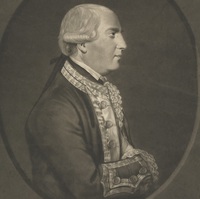
Rear-Admiral John Elphinstone.
In the course of the war, the Russian fleet engaged with Turkish forces across the Aegean - Evia, Skiathos, Mykonos, Santorine, Patmos, Naxos, Milos, Rhodes, Cos, Chios, Lesvos, Samos, Thasos, Imbros, Tenedos and Lemnos - all were visited by the Russian Fleet and became involved in the war. Engagements also occurred around the Peloponnese and as far as Egypt and Cyprus.
The Russian Fleet not only engaged the Ottoman Fleet but also landed on various Aegean Islands, besieged Ottoman fortresses and were supported in the various harbours of the region.
Battle of Chesme
The most famous engagement was the Battle of Chesme, fought in the great bay north of Chesme and subsequentl in the port of Chesme itself. After the initial engagement in the bay during the 5th July 1770, the Russians pursusd the retreating Ottoman fleet to the port, sending in a small fleet including fire and bomb ships in the morning of the 6th July to wreak havoc amongst the Ottoman Fleet. This force of 4 battleships, 2 frigates a bomb-vessel and a number of fire ships was commanded by the Flag Captain Samuel Grieg, a Scottish naval officer. Other officers in this force were a Lieutenant Dugdale and Sub-Lieutenant Prince Gargarin. 11 Ottoman battleships were destroyed and one captured. Later in the war, Grieg, now a Rear-Admiral, would return to Chesme on 9th November 1772 land troops and take control briefly of Chesme port.
After this victory, the Russian Fleet had command of the Aegean and proceeded to blockade the Dardanelles straits - that force under the command of the British Rear Admiral John Elphinston. During this time Russian battleships sailed the waters between Imbros and Gallipoli, with some sheltering in the harbours of Imbros and Tenedos.
Battle of Chios Chesma by Ivan Aivazovsky 1848. Wikipedia.
Gravour showing the first day of the Battle of Chesma. Wikipedia.

The Russians at Lemnos 1770-1771
Towards the end of July the Russian Fleet arrived at Lemnos - no doubt appreciating the advantage of its large bay at Mudros. On the 26th July 1770, Admiral Count Alexie Grigoryevich Orlov sailed into Mudros Bay. He then joined the rest of the Russian Fleet (with the exception of Elphinston's ships blockading the Dardanelles) on the other side of the Island at what was then called Pelari (most probably Kastro, now Myrina), bombarded the Turkish forces there and  landed 1,300 men and began to besiege Kastro on 3rd September. Although the Ottoman commander agreed surrender on 5th October, the arrival of 21 Ottoman ships and the landing of fresh troops on Lemnos, resulted in Admiral Orlov lifting the siege and sailing for Paros on 7th October.
Prior to this, on the 16th September 1770,  Rear-Admiral Elphinston sailed from Imbros to Lemnos and ran aground to the north-east of Lemnos.
Russian warships returned to Lemnos (and Tenedos and Lesvos) under Admiral Elphinston in early December 1770. In the following year, Russian warships returned to Lemnos - on 13th April and 10th June 1771.
Memorials to Admiral Orlov's Fleet and its arrival on Lemnos have been erected at both Myrina and Moudros on Lemnos.
1770 and 1807 Russian Memorial, Roman Shore, Myrina, Lemnos. Photo Jim Claven 2013

1770 and 1807 Russian  Memorial, Roman Shore, Myrina, Lemnos. Photo Jim Claven 2013
 
1770 Memorial, Agios Evangelismos, Mudros, Lemnos. Photo Jim Claven 2013


Greek Revolt
The fleet reached Mani in February 1770, prompting the Maniots to raise their war flags. Russian soldiers remained to help fight in the ground war, while the fleet sailed on to the Aegean Sea. The Greek army was initially successful, quickly liberating large portions of Morea. The revolt however failed to effectively spread in the rest of Greece—with the notable exception of Crete, under the leadership of Ioannis Vlahos (known as Daskalogiannis). However, the support promised by the Russian emissaries never arrived at Crete and Daskalogiannis was left to his own devices. However as the Russians failed to bring forces to the Peloponnese, the revolt was soon crushed. The failed revolt resulted in the death of the noted preacher and monk (later canonized) Cosmas of Aetolia, who was arrested and executed in 1779 on suspicion of being a Russian agent.
1807 - The Russians and British Return to Lemnos
This Russo-Turkish war broke out in 1805–1806 and raged until 1812 across land and sea
In 1806, Sultan Selim III, encouraged by the Russian defeat by the French at Austerlitz, deposed the pro-Russian Constantine Ypsilanti as Hospodar of the Principality of Wallachia and Alexander Mourousis as Hospodar of Moldavia, both Ottoman vassal states. Simultaneously, the French Empire occupied Dalmatia and threatened to penetrate the Danubian principalities at any time. In order to safeguard the Russian border against a possible French attack, a 40,000-strong Russian contingent advanced into Moldavia and Wallachia. The Sultan reacted by blocking the Dardanelles to Russian ships and declared war on Russia.
In 1807, the Russian Fleet, allied to the British, sailed into the Aegean to engage with the Ottoman Empire. They would sail to and land on many of the Islands of the Aegean, aided by Greek sailors and ships, including Imbros, Tenedos and Lemnos.
On June 5th the British Captain Commodare A Grieg commanded four Russian battleships as they sailed to Lemnos from the Dardanelles. On the 15th June 1807 Grieg landed a force of 800 men on Lemnos. Following a Russian naval diversion off the north of Lemnos, Grieg's force was ordered to re-embark on the 18th June and to sail for Tenedos.
In the meantime, the Russian Imperial Navy under Dmitry Senyavin blockaded the Dardanelles and defeated the Ottoman fleet in the Battle of the Dardanelles, after which Selim III was deposed. The Ottoman fleet was destroyed the following month in the Battle of Athos, thus establishing Russian supremacy on sea for the duration of the war.
Russian Fleet after the Battle of Athos by Alexey Bogolyubov. Wikipedia.

See the Battle of Chesme Painting in Melbourne
The original painting - The destruction of the Ottoman Fleet in the Bay of Chesme - reproduced at the top of this page - can be seen at the National Gallery of Victoria as part of its current new exhibition - Masterpeices from the Hermitage: the Legacy of Catherine the Great. The exhibition concludes on 7th November 2015. for information on the exhibition click here.

Information sourced from RC Anderson, Naval Wars in the Levant 1559-1853, University of Liverpool Press, 1952 and wikipedia.

Jim Claven
Secretary
Lemnos Gallipoli Commemorative Committee

Monday, 19 October 2015

You are invited - Lemnos 1915 Photographic Exhibition at Richmond Town Hall Friday 30th October 2015

On the 97th anniversary of the signing of the Armistice of Mudros ending the war in the Middle East, the City of Yarra and the Lemnis Gallipoli Commemorative Committee will be hosting an exhibition and reception.
The Committee is very glad that the City of Yarra has agreed to host this event.
The exhibition is the Committee's photographic exhibition featuring 40 of the most iconic images from the huge archive of photographs taken by the Anzacs - diggers and nurses - on the Island of Lemnos in 1915.
You are all invited to attend this exhibition and reception:
6.30pm, Friday 30th October 2015
Richmond Town Hall.
RSVP 92055096 (leave a message) or mayorandcouncillorsevents@yarracity.vic.gov.au

Thanks to Mayor Clr Phillip Vlahogiannis for supporting and promoting this event.

Jim Claven
Secretary
Lemnos Gallipoli Commemorative Committee

Sunday, 18 October 2015

115 Years of the Greek Australian Alliance Booklet


2016 will be the 75th Anniversary of the Battle of Crete and Greek Campaign of 1941.
The Australian Joint Committee for the Commemoration of the Battle of Crete and Greek Campaign has had produced a booklet outlining some of the key connections between Australia and Greece - from Greek Australians serving in the Australian forces fighting in the Boer War, through the role of Lemnos in the Gallipoli campaign, Australians serving on the Salonika Front, Australian refugee aid workers after WW1 including Major George Treloar and Sidney and Joyce Loch, to the service of Greek and Australian servicemen and women in WW2 and beyond.
It also has an interesting map of Greece identifying some of the key of the Greek Australian connection.
You can view and download the booklet by clicking on the following link - 115 Years of the Greek Australian Alliance 1899-2014
Thanks to Christina Despoteris for this information.
Jim Claven
Secretary
Lemnos Gallipoli Commemorative Committee

Wednesday, 14 October 2015

Lemnos Gallipoli Unveiling - Speeches Booklet & RSL Hellenic Sub-Branch Newsletter Released

The Lemnos Gallipoli Commemorative Committee has released its latest publication - The Lemnos Gallipoli Memorial: The Unveiling Event and Key Speeches.
This booklet has been prepared to both document the great unveiling event for our Memorial held on the 8th August 2015 and to bring the speeches delviered at the event to a wider audience.
Many people have contacted the Committee expressing their apologies for not being able to attend the event. They will now be able to read the key addresses from the day and see the pictures of the event.
The booklet contains a message from our President, Lee Tarlamis, a report of the event itself and a number of speeches from the day.
Of especially importance are those speeches given by the many descendants of nurses and diggers who served on Lemnos in 1915. We were especially honored by their presence and participation. The Committee is keen to make their stories and reminiscences of their ancestors to a wider audience. We thank them for making their speeches available.
The booklet was prepared by myself as Secretary.

You can view and download the booklet by clicking here.
We hope you enjoy the booklet.

RSL (Victoria) Hellenic Sub-Branch Newsletter - October 2015
Also please find below a link to the latest newsletter of the RSL Hellenic Sub-Branch. This edition contains a report and photographs of our unveiling. The Sub-Branch has been a keen supporters of the work of our Committee.
Click here to view and download the Newsletter.

Jim Claven
Secretary
Lemnos Gallipoli Commemorative Committee